
How Agentic AI is Optimising Contact Centres and Customer Experience in Banking
Traditional customer support models are no longer able to meet customer expectations in banking. Such is the pace at which the latter has increased. There’s a gap and it’s growing. Simultaneously, it is driving the transformation of intelligent and autonomous systems powered by agentic AI. In fact, it is at the heart of this change, as traditional contact centres, which used to be considered cost centres, are being rethought as strategic value creators.
Unlike legacy automation or simple chatbots, agentic AI systems operate as intelligent co-pilots: they perceive intent, maintain evolving conversation context, and orchestrate proactive workflows. This development is reshaping how customer interactions take place in banking, elevating both contact centre performance and the broader intelligent banking customer support experience.
Beyond Automation: The Strategic Power of Agentic AI
The term “agentic AI” refers to AI agents that independently perform goal-orientated tasks with the ability to reason, act, and collaborate. In banking, these agents do far more than answer questions; they interpret customer emotions, anticipate needs, retrieve relevant data, and support human agents in real time. Acting as intelligent copilots in contact centres provide useful prompts, summarise conversations, and surface task-specific workflows based on customer intent.
In live voice-based support that uses real-time transcription, sentiment detection, contextual retrieval, and modular workflows. The agentic AI assistant maintained and evolved conversational context, significantly improving handling times and first-call resolution. This is not just automation; it is a form of augmented intelligence that empowers human agents while scaling operations.
Driving Efficiency in Banking Contact Centres
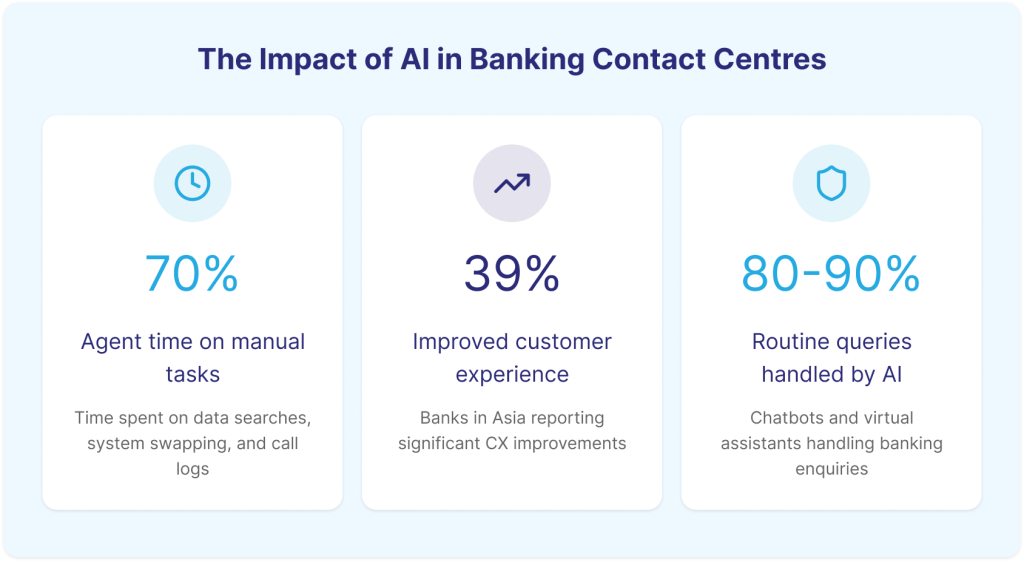
Banking contact centres have almost always been characterised by operational inefficiencies. According to Capgemini, manual processes, such as data searches, swapping systems, and call logs, occupy up to 70% of the working time of an agent. Also, over 60% of customers evaluate their chatbot experience on average, and 61% contact human agents due to their inability to resolve their issues satisfactorily using automated responses. AI in banking contact centres is emerging as a crucial enabler in closing this gap.
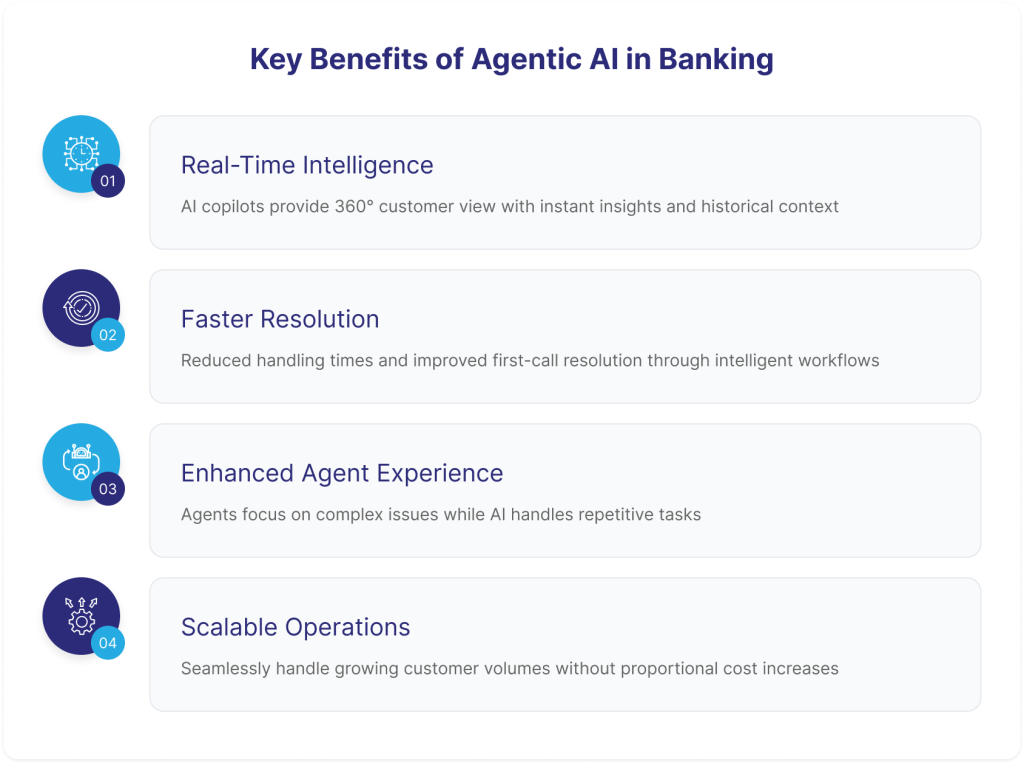
Agentic AI offers a compelling solution by augmenting agents’ capabilities. Such AI copilots are able to communicate with various internal systems, present pertinent customer information, refer to the appropriate workflows, and even draft responses. Consequently, human agents are able to devote their time and energy to the complex, emotionally layered problems rather than manual, back-office tasks. Capgemini’s research even suggests that with intelligent contact centres, the time agents spend on operational tasks can be optimised, creating more headroom for strategic engagement.
Enhancing Customer Experience through Intelligent Banking Support
On the other hand, agentic AI can alter the experience in concrete ways, as the customer would see it. Systems powered by AI can help reduce resolution times, build more holistic cross-channel experiences, and provide highly personalised customer care with minimal friction. Moreover, by consolidating information about customers, their history, sentiment, and previous interactions in real time, agentic AI makes each interaction more context-rich and effective.
In Asia, many banks are already reporting measurable gains: 39% note significant improvements in customer experience, while 36% cite enhanced operational efficiency. These indicators reflect a broader transition toward smarter, more empathetic banking experiences, a shift that underscores the rising importance of AI for banking experiences.
Scaling Automation in Banking Operations
Frontline customer service is not the only area that agentic AI will impact in the banking sector. The intelligent agents can orchestrate entire processes; they can guide customers through the process of opening new accounts, escalating fraud notices, or directing complaints. They also support automation in banking operations by streamlining reporting, maintaining consistency in decision-making, and applying predictive analytics.
In many banks, these tools are proving to be transformational: they help scale operations, reduce risk, and free up human expertise for higher-value tasks. Chatbots and virtual assistants already handle a substantial share of common banking enquiries: some reports suggest that AI now handles 80–90% of routine banking questions. AI agents further extend this capacity by bridging the gap between simple query resolution and complex, multi-step banking processes.
Converting Contact Centres into Value Engines
The true strength of agentic AI is in the fact that it transforms the contact centre into a value source rather than a cost centre. Banks can unlock upselling and cross-selling opportunities by enabling real-time intelligence on the agents in a manner that is non-invasive and natural. Capgemini notes that generative AI copilots provide agents a 360 view of customers with insights, historical background, and intelligent prompts that comply with and satisfy customer objectives.
Such a strategy enhances increased agent interaction as well. The agents will be able to spend more time building trust, solving complexities, and fostering relationships instead of getting lost in repetitive assignments, which are complemented by AI doing most of the heavy lifting.
Risks and Governance: A Responsible Approach
Adoption of agentic AI in banking is not without challenges. Banks must be vigilant about data privacy, regulatory compliance, and transparency. Every automated decision must be auditable, and human oversight remains crucial, especially in financial contexts where trust is paramount.
Additionally, the banks are required to incorporate guardrails where AI agents will effectively cooperate with human agents and escalate when needed, without being overambitious. The future of smart banking customer care will not only rest on the technical abilities, but the workflows, governance frameworks, and ethical behaviours should be formulated with care.
Future Outlook: AI-Driven Customer Experience in Banking
The next stage of customer interaction in banking will be agentic AI as an intelligent partner in contact centres. These context-sensitive, autonomous agents, by collaborating with human representatives, contribute to the establishment of highly efficient interaction centres that address enquiries faster, more accurately and personally relevantly. This shift allows banks to unify insights, automate complex workflows, and deliver support that adapts in real time to customer intent.
As adoption accelerates, banks can expect meaningful operational advantages, from reduced service costs and fewer escalations to improved customer satisfaction and higher first-contact resolution. Human agents, supported by AI copilots, will be able to dedicate more time to advisory-focused interactions, strengthening trust and deepening relationships across the customer lifecycle.
In Conclusion
Agentic AI is a significant development in the way banks deliver service. Its worth is much more than automating tasks; it transforms the paradigm of the whole customer support, adding cognitive intelligence, contextual awareness, and the active coordination of tasks to each interaction. When responsibly deployed, these systems assist the banks in providing service that is more human-responsive, quicker, and more reliable.
This will help banks respond to increasing customer expectations in the future, enhance efficiency within the banks by incorporating agentic AI in contact centres, and improve internal operations, thereby providing a more resilient and scalable foundation for future customer experience strategies.
Ready to Modernise Your Banking Customer Experience?
If your organisation is exploring agentic AI for contact centres or broader customer experience transformation, contact us today to begin your journey with a tailored consultation.