How To Implement Agentic AI in the Public Sector - A Practical Guide
Governments around the world now face escalating demands to deliver more personalised, efficient services while being constrained by budgets and legacy systems. However, the promise of agentic AI in the public sector, where autonomous agents act, learn, and assist across workflows, stands out against this backdrop as a compelling evolution of AI in the public sector.
This blog provides a structured path for public sector firms to effectively adopt AI solutions for government, drawing on real-world data and clear strategic steps.
Understanding Agentic AI for Governments
In contrast to conventional tools, which merely analyse the data or answer questions, agentic AI is far more proactive: it monitors the conditions, activates processes and takes measures within a prescribed governance. To illustrate, a system agent in a municipal system may notice that a fire pump is about to fail and will schedule maintenance with minimum human intervention. In the context of the public sector, leveraging intelligent automation in governments via these agents offers improved responsiveness and supports mission-critical decisions.
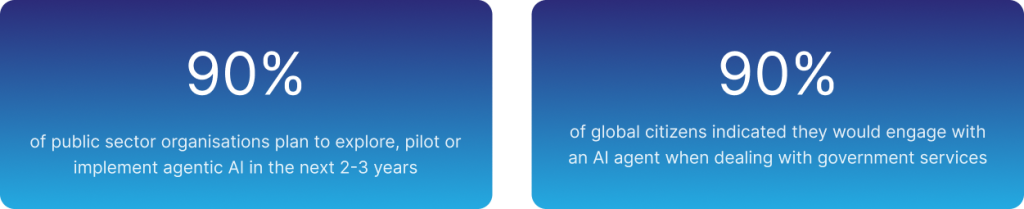
Studies have shown that 90% of public sector organisations plan to explore, pilot or implement agentic AI in the next two to three years. Meanwhile, citizens appear ready: 90% of global respondents have been reported to indicate they would engage with an AI agent when dealing with government services.
Key Benefits for the Public Sector
When executed, AI solutions for the public sector can deliver substantial value. First, there is enhanced service delivery as agents anticipate the needs of citizens, individualise them, and reduce burdensome procedures.
Second, operational efficiency improves because agents handle rule-based or repetitive workflows, freeing human staff to focus on higher-value, strategic tasks. Third, decision-making strength increases as the agents analyse vast data volumes and generate actionable insights for policymakers. The combined effect enables governments to respond more rapidly and adaptively to citizen needs, further positioning AI in government sector modernisation efforts.
Implementation Roadmap
To embed agentic AI in the public sector, a disciplined process is necessary:
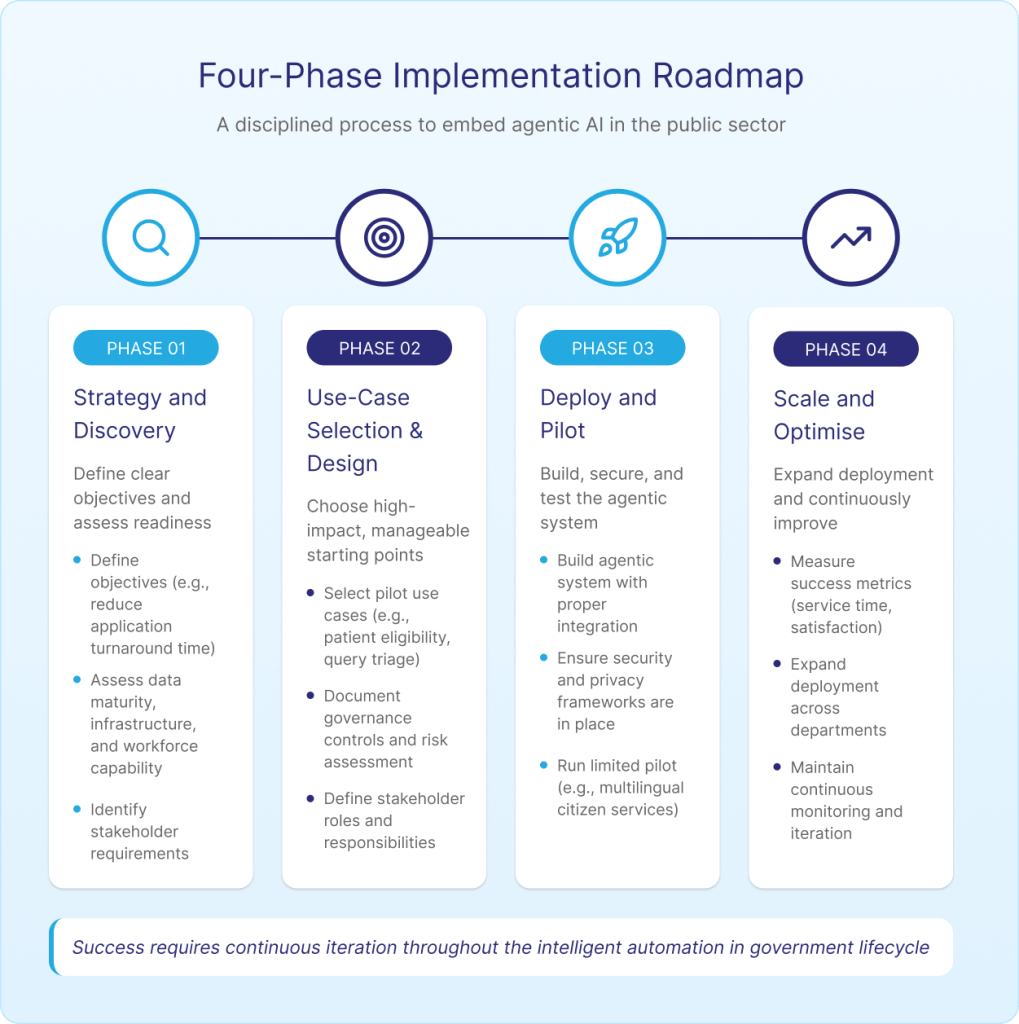
Strategy and Discovery
Public organisations must define clear objectives: for example, reducing application turnaround time for social benefits or automating permit review. A readiness assessment should cover data maturity, infrastructure, and workforce capability.
Use-case Selection and Design
Choose high-impact, manageable starting points. Examples: a patient-eligibility agent in social welfare; an AI agent to triage queries in citizen services. Document governance controls, risk assessment, and stakeholder roles, with governance controls, risk assessments, and stakeholder roles clearly defined from the outset.
Deploy and Pilot
Build the agentic system with proper integration, ensure security and privacy frameworks are in place, and then run a limited pilot. For instance, facilitating interactions with benefits services for multilingual citizens is important.
Scale and Optimise
Once success metrics (e.g., service time reduction and citizen satisfaction) are met, expand deployment across departments. Maintain continuous monitoring and iteration as part of the intelligent automation in the government lifecycle.
Common Obstacles and Mitigation
Despite the promise, many public sector bodies encounter hurdles. A key barrier is insufficient data readiness: only 21% of public sector organisations reported having the data infrastructure needed to train advanced AI models. Additional challenges include limited trust in AI-generated outputs (74% flagged this) and concerns about compliance with evolving regulations.
The governance perspective introduces a demand for increased supervision of the departments because the introduction of agents requires integrated control, constant tracking, and an open system. These can be countered by adopting effective data management structures, training the workforce, and laying out evident AI ethics provisions and transformative governance at the beginning of the lifecycle.
Real-World Use Cases in the Public Sector
In practice, some governments are piloting agents that engage citizens directly: for instance, when a user applies for welfare support, an agent might ask clarifying questions, identify additional eligible programmes and complete applications on behalf of the user.
Other examples include fraud detection systems analysing transaction data continuously to flag anomalies and improve oversight in tax or customs functions. These use cases of AI in government highlight how authoritative public organisations are leveraging agentic systems to serve citizens, reduce costs and strengthen operations across the expanding AI in government sector landscape.
Best-Practice Checklist for Public Sector Leaders
Start with a clear mission-aligned objective (e.g., reduce waiting time for citizen services or improve permit-issuance accuracy).
In Conclusion
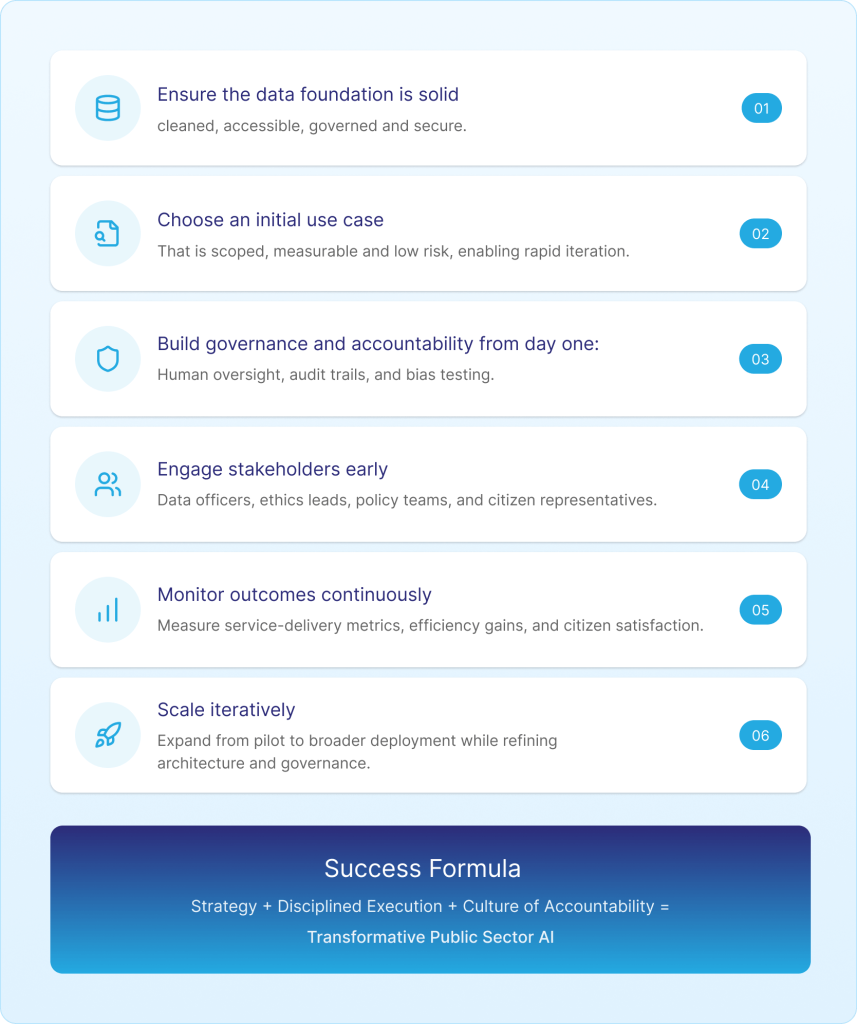
Implementing agentic AI in the public sector demands more than technology; it calls for strategy, disciplined action, and a culture of accountability. When done,, AI solutions for the public sector deliver superior citizen service, more efficient workflows, and stronger decision-making. Public organisations that embrace intelligent automation in government stand to redefine how they operate, meet citizen expectations, and respond to the complex challenges of governance. The time for transition is now.
Reach out today to shape a secure, scalable agentic AI strategy for your department.