How Can Enterprises OrchestrateAgentic AI Across Systems?
Gartner predicts that by 2026, 40% of enterprise applications will have AI agents that perform specific tasks. Yet, only a few organisations today have the governance frameworks to handle them successfully.
This is a great concern for businesses now. Merely using AI is not sufficient. The challenge for enterprises today is to manage agentic AI across systems, with security as a key concern, while maintaining a seamless workflow and gaining greater control over the operation. This blog will delve into the concept of connected orchestration and how organisations can leverage data integration, governance, and interoperability to enable scalable and reliable AI execution.
Understanding Agentic AI in Enterprise Environments
Agentic systems can independently reason, plan and act within enterprise settings. They have the capability to understand context, make decisions, interact with applications and manage workflows while requiring little to no manual effort, unlike traditional automation tools.
Orchestration integrates seamlessly with multiple ERP platforms, CRM systems, cloud solutions and workflow applications, allowing businesses to run smoothly. If several intelligent systems are integrated across departments and across applications, then businesses can be able to help execute faster and more responsively in their day-to-day business.
Why Enterprises Struggle With AI Orchestration
Despite growing investment, many organisations still struggle with disconnected systems, fragmented infrastructure, and inconsistent data environments. These challenges can make daily operations harder to manage and reduce coordination across teams and systems. Common issues include:
- Siloed data and disconnected systems
- Older platforms with limited integration
- Weak governance and security controls
- Limited visibility across workflows
- Gaps between business and IT teams
Along with connected systems, businesses also need better monitoring, access control, and operational oversight to keep processes running smoothly.
1. Build a Unified Enterprise Data Foundation
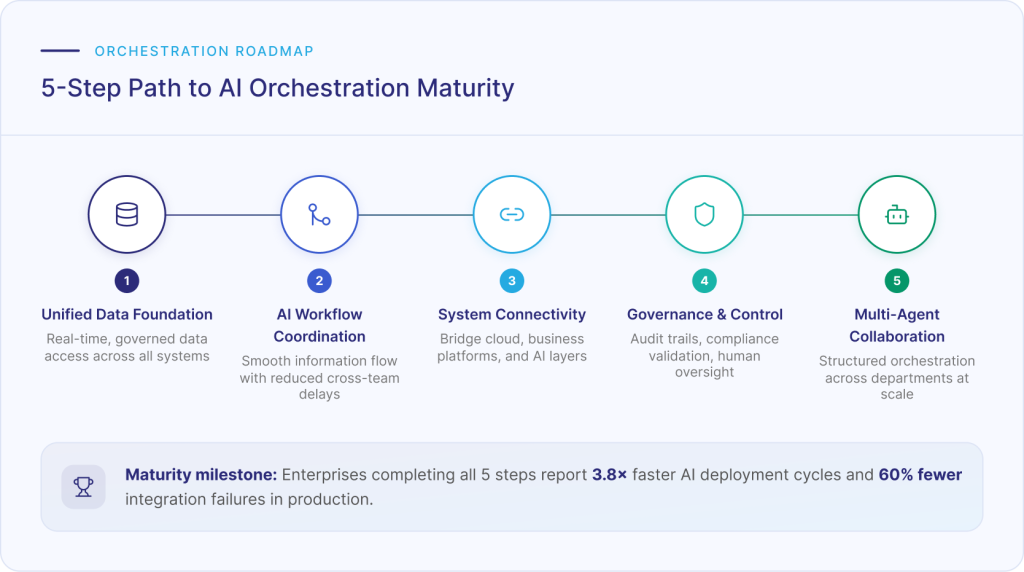
The foundation for orchestrating agentic AI is a connected and reliable data environment. AI agents must have access to real-time, unified information across systems to power enterprise business architectures. An AI execution layer needs to be built up comprising the following:
- Connecting systems and applications across the business
- Creating shared standards for data and governance
- Improving access to real-time information
- Keeping data accurate and consistent
- Managing secure access across operations
These foundations help to ensure enterprise AI is executed in a coordinated and reliable way.
2. Improve AI-Driven Workflow Coordination
Once systems and data are connected, companies can improve how AI-supported workflows move across teams, applications, and daily operations. Better orchestration helps information flow more smoothly, reduces delays, and supports stronger coordination between automated processes and employees.
3. Building Connectivity of AI and Business Systems
Business platforms, cloud environments and workflow applications work best when they are connected rather than in silos. AI-enabled processes are more resilient to disruption, better collaborate with business applications, and are more connected with the system, all of which lead to smoother communication.
4.Employee productivity gains
As AI orchestration expands across enterprise environments, organisations need strong governance frameworks to maintain visibility, accountability, and secure execution. Clear policies, audit mechanisms, human oversight, compliance validation, and performance monitoring help manage how AI-driven workflows interact with systems, applications, and enterprise data.
5. Enable Scalable Multi-Agent Collaboration
The impact of AI orchestration truly comes into play when multiple AI agents, enterprise systems and workflows work in synergy across departments and platforms. Structured orchestration environments are required by businesses to communicate, align tasks, keep the workflows continuous, and make operations transparent at scale.
This allows for seamless integration of AI-driven processes with enterprise systems, leading to more efficient operations, faster execution, and a more responsive business environment.
Building Sustainable AI Execution Frameworks
Choosing the right AI model is just the beginning of a successful enterprise AI implementation. Organisations must have sustainable operational architectures equipped with the capabilities of orchestration, governance, and interoperability, as well as continuous monitoring, to drive effective scale-up of AI initiatives.
Key requirements include:
Explore our agentic AI solutions!
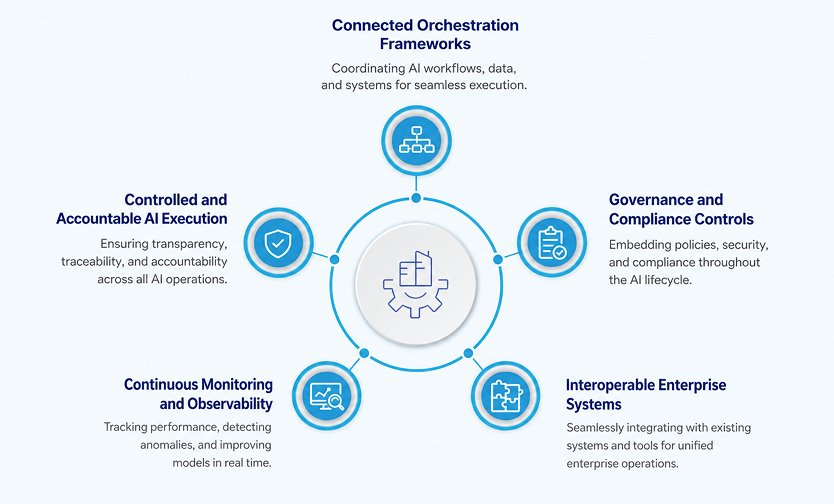
These foundations enable AI agents to operate reliably across enterprise environments while reducing operational complexity.
The Path to Connected AI Execution – The Right Partner
The adoption of agentic AI orchestration calls for a particular set of capabilities: enterprise integration, workflow management, data architecture, and data governance frameworks. SquareOne can assist organisations in creating connected operational environments and securely and scalably execute AI across the enterprise system via orchestration frameworks, workflow modernisation and governance-driven approaches.
In Conclusion
Orchestration enables connected, rather than isolated, AI systems to be the future of enterprise AI. For reliable AI execution at scale, enterprises should have integrated data environments, orchestration frameworks, data interoperability, data governance, and coordinated multi-agent systems. This ability to establish these pillars will enhance the capability of organisations to manage operational coordination, responsiveness and enterprise-wide AI implementation.
Looking to build a connected enterprise architecture for agentic AI execution?
Explore how SquareOne can help your organisation orchestrate AI across enterprise systems with greater control, visibility, and operational alignment.