
From Full System Copies to Intelligent Provisioning
Rethinking SAP Test Data Management with Qlik Gold Client
The demands on test data management have grown alongside SAP landscapes as they continue to evolve. Development teams need to release changes faster, support continuous testing, and meet compliance requirements, all while working with test data that accurately reflects production.
Yet, many organisations still rely on full SAP system copies to create non-production environments. While this has long been the standard approach, it often leads to longer refresh cycles, higher infrastructure costs, unnecessary data duplication, and increased administrative effort.
As a result, many SAP teams are moving away from full system replication and adopting a more selective approach to provisioning test data. Rather than replicating complete systems, they are using solutions such as Qlik Gold Client to provision only the data needed for specific business processes. This creates smaller, more manageable test environments that are quicker to refresh and easier to maintain.
This blog looks at why selective data provisioning is replacing traditional system copies and how it helps organisations build faster, leaner, and more effective SAP test environments.
The Scaling Limits of Homogeneous SAP System Copies
A common approach for refreshing QA, sandbox, and training environments is performing full homogeneous system copies from production. While this ensures consistency, it also replicates the full size and complexity of production landscapes. As SAP systems grow from terabytes to tens of terabytes, this model becomes increasingly unsustainable. Every refresh consumes significant storage, infrastructure capacity and management effort. It also introduces downtime for development environments, often leaving teams with outdated or inconsistent test data.
Beyond infrastructure costs, the operational burden is equally significant. Backup, restore, and refresh cycles slow development velocity, extend testing timelines, and delay migration programmes. Nonproduction systems must, therefore, be redefined not as replicas of production, but as purpose-driven environments aligned to specific business and testing objectives.
From Data Volume to Business Relevance
Effective test data management is not about reducing data volume arbitrarily. Au contraire, it is about provisioning business-relevant data that supports complete end-to-end process validation. Instead of copying entire SAP landscapes, organisations should provision only for the master and transactional data required for meaningful business execution.
For example, a sales order alone is insufficient for realistic testing. A complete scenario requires line items, document flow, deliveries, invoices, financial postings, and associated master data such as customers, materials, and pricing structures. This relationship-aware approach ensures that non-production environments behave like production from a functional perspective, without carrying unnecessary historical or redundant data. The result is a leaner environment that preserves business integrity while significantly reducing system footprint.
Selective Provisioning vs Full System Replication
Modern SAP Test Data Management software, such as Qlik Gold Client, enable selective data movement between systems without relying on full system copies. Instead of duplicating entire landscapes, organisations can provision only the required business objects, such as company codes, purchase orders, sales orders, financial periods, or defined transactional sets.
Data is extracted from the source SAP, compressed and encrypted into secure files, and then imported into the target environment. These files remain accessible only through the provisioning tool, ensuring controlled data management and governance
This method ensures precise, targeted provisioning aligned with specific development, testing, or migration requirements while avoiding unnecessary replication of production systems.
Preserving SAP Data Relationships
SAP environments are built on tightly connected master and transactional data models; maintaining these connections is crucial for meaningful testing.
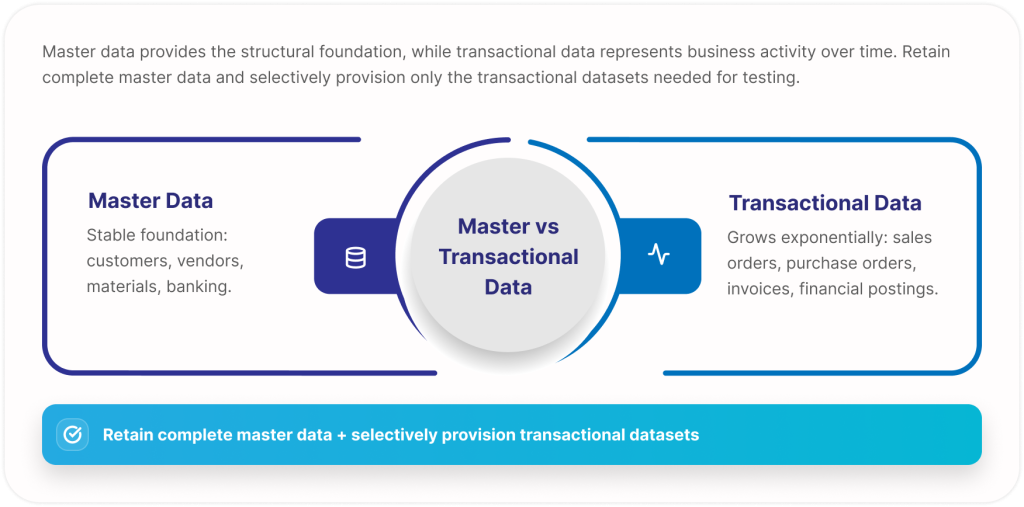
Master data, such as customers, vendors, materials, and banking information, forms the structural foundation of the system. Transactional data, including sales orders, purchase orders, invoices, and financial postings, represents business activity over time. In most company environments, transactional data grows exponentially, while master data remains relatively stable. Retaining decades of transactional history in non-production systems often adds limited testing value. A more effective approach is to retain complete master data while selectively provisioning relevant transactional datasets needed for specific testing cycles, as this ensures functional accuracy without unnecessary data accumulation.
Lean and Continuously Available SAP Environments
Non-production SAP systems are often disrupted by repeated backups and system refresh cycles. This leads to downtime, delayed testing, and fragmented development environments.
Modern provisioning approaches enable data to be introduced into active systems while production continues to operate.
This removes the need for frequent full system refreshes and allows QA, sandbox, and training systems to remain continuously available.
The outcome is a leaner, more agile SAP landscape with reduced infrastructure load and minimal operational disruption. It is paramount to note that system reduction must never compromise data quality. The main objective is to maintain environments that remain fully representative of production business processes while operating efficiently.
The main objective is to maintain environments that remain fully representative of production business processes while operating efficiently.
Reusable Test Data for Faster and Efficient Delivery
Another key capability in modern test data management is the reuse of previously provisioned business conditions. Instead of recreating test data sets for every cycle, organisations can capture specific business scenarios, such as purchase orders, stock situations, or financial transactions, and reuse them across projects.
These reusable datasets support regression testing, validation cycles, and ongoing quality assurance while ensuring consistency across testing environments. This reduces repetitive setup effort and accelerates SAP development and release cycles, making it an effective enterprise SAP testing solution for continuous delivery initiatives.
Embedding Data Privacy in Provisioning Workflows
Data protection and regulatory compliance are increasingly critical in SAP landscapes.
Modern provisioning approaches allow anonymisation rules to be applied during the export process itself. Sensitive data such as customer names, financial details, and personal identifiers can be masked before being introduced into non-production environments.
This ensures that sensitive production data is never exposed in raw form outside the source system. Anonymisation rules can also be applied within sandbox environments where required, providing flexibility across different testing scenarios.
This rule-based approach aligns SAP testing processes with enterprise governance and data privacy requirements.
Selective Provisioning in Large-Scale SAP Transformations
Large SAP transformation programmes require frequent testing across multiple migration scenarios. Full system copies slow these efforts because they take time to create and often disrupt ongoing operations.
Selective provisioning solves this by extracting only the company codes, business periods, and transactional data needed for a specific scenario. Teams can quickly create production-representative test environments, run multiple testing scenarios in parallel, and restore environments faster when required.
Efficiency Without Arbitrary Reduction Targets
The objective of SAP test data management is not simply to reduce data volume. It is to provision the right production-representative data for testing while avoiding unnecessary infrastructure and operational overhead.
Although organisations often reduce the size of non-production systems, the actual reduction depends on their SAP landscape and business requirements. The true measure of efficiency is delivering relevant test data that supports accurate, reliable testing.
In Conclusion
Modern SAP test data management is moving beyond the traditional model of full system replication. Most organisations require provisioning strategies that support agility, governance, and business continuity as SAP intelligent enterprise solutions continue to evolve.
The focus is shifting towards intelligent, selective provisioning that delivers business-relevant data while reducing infrastructure overhead and operational complexity. By saving data relationships, maintaining lean environments, enabling reusable test datasets, and embedding privacy controls into provisioning workflows, organisations could significantly improve SAP testing efficiency and system agility. The future of SAP test data management is defined by how precisely the right data is delivered to support business execution, and not by how much data is copied.