
7 Ways Agentic AI is Revolutionising Banking Operations
Banking is entering a pivotal phase where traditional models are losing relevance. Increasing regulatory demands, evolving customer expectations, and growing competition from fintech players are evolving how financial institutions operate. Processes once guided by manual oversight and rigid automation now fall short in an environment that demands greater speed, precision, and adaptability.
The idea of agentic AI introduces a new approach that relies on self-learning systems that can make smart decisions based on the specific tasks they are designed to handle. With the introduction of flexibility in fundamental business processes, banks are opening up opportunities for agility and compliance.
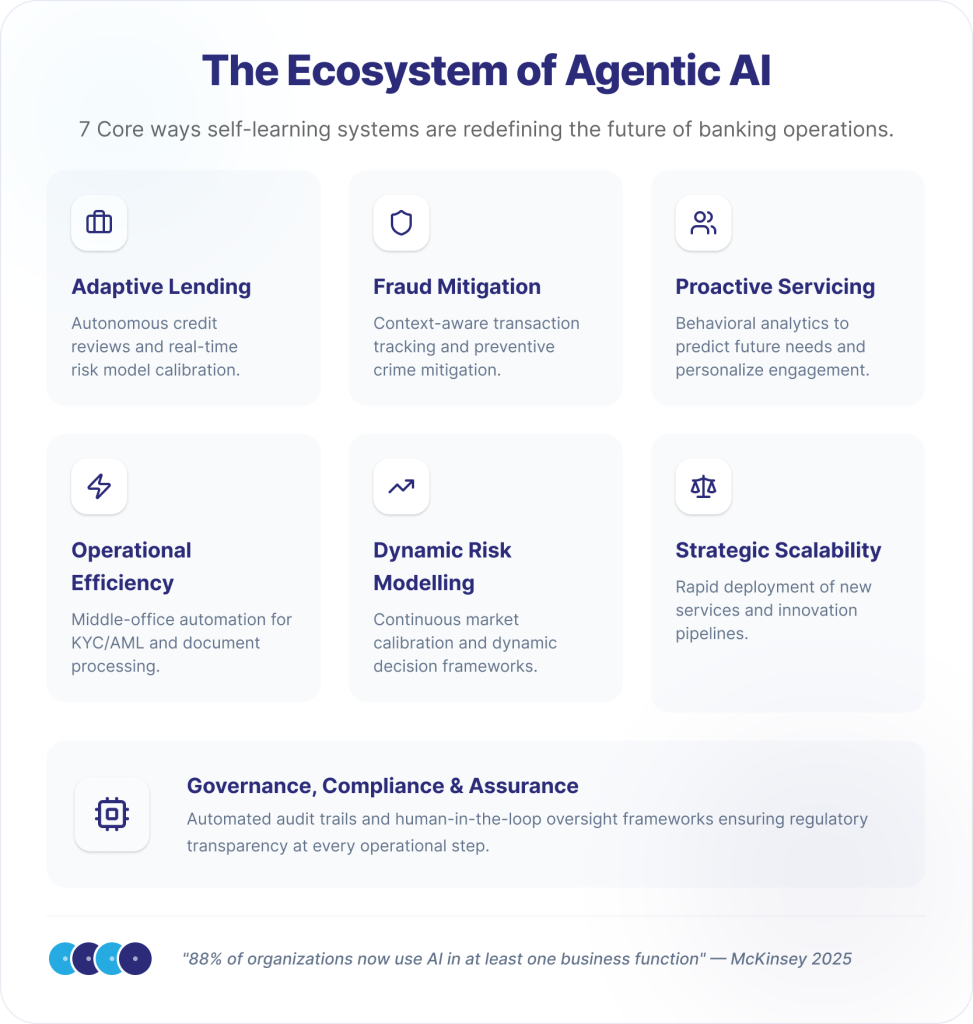
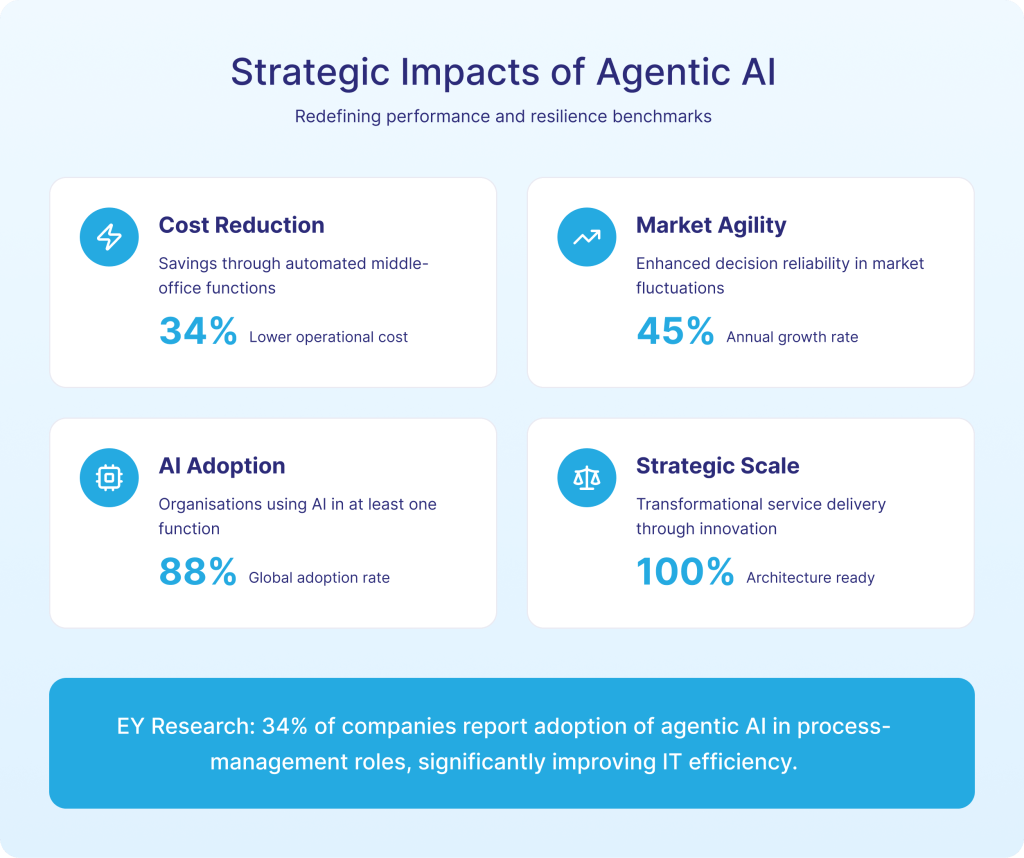
According to McKinsey’s The State of AI in 2025 global survey, 88 per cent of organisations now use AI in at least one business function, with adoption rising rapidly across sectors, including financial services. In this blog, we examine seven pivotal ways agentic AI in banking is reshaping operations and setting new benchmarks for performance and resilience.
Key Ways Agentic AI is Transforming Banking Operations
Adaptive Lending and Risk Assessment
Agentic AI enables banks to re-engineer traditional loan-processing workflows by autonomously reviewing credit applications, verifying identity, and calibrating risk models in real time. Research from McKinsey emphasises that agent-based AI is poised to reshape retail banking decision-making. By automating routine tasks and using smart logic for each customer, AI banking solutions help banks speed up approvals, cut down on mistakes, and let their teams focus on priority work.
Enhanced fraud detection and financial crime mitigation
In areas where timing and context are critical, agentic AI for banking outperforms traditional rule-based systems by constantly tracking transactions, identifying unusual patterns, and taking preventive action. Boston Analytics Institute (BAI) research shows that banks using agentic AI are already seeing strong results in fraud prevention, portfolio monitoring, and AML functions. This intelligent automation helps reduce risk, enhance compliance, and build stronger security across workflows.
Personalised customer engagement and proactive servicing
Banking AI solutions with agentic intelligence can understand user behaviour, predict future needs, and recommend suitable financial products or adjustments as life situations evolve. Industry experts note that shifting from reactive service models to proactive digital assistants allows banks to build more meaningful and responsive relationships with their clients. By interacting through these intelligent systems, institutions can strengthen customer loyalty, increase satisfaction, and uncover new opportunities for personalised service.
Operational cost reduction and workforce augmentation
Intelligent automation in banking, supported by advanced AI solutions for banks, extends to middle- and back-office functions: account onboarding, KYC/AML verification, document processing, and workflow coordination. A 2025 EY survey shows that among companies investing in AI, 34% report adoption of agentic AI in process-management roles, including customer support (55%) and IT efficiency (55%). These changes lead to cost savings, quicker processes, and more consistent results.
Risk modelling, portfolio management, and real-time analytics
By introducing continuous risk calibration and dynamic decision frameworks, agentic AI redefines how banks manage uncertainty. The World Economic Forum identifies these AI-driven systems as enablers of high-speed data interpretation and improved decision reliability. As an outcome, institutions gain the agility to anticipate and adapt to fluctuations in the market and regulatory landscape.
Strategic scalability and innovation enablement
As banks integrated agentic AI into their core architecture, they supported the development of new services, delivery models, and automation pipelines. As per the market statistics, the AI-agent market is projected to scale at a strong rate; one estimate indicates an annual growth rate of nearly 44.8% through the end of the decade. This development enables the banking institutions to go beyond the growth of incremental improvement to transformational service delivery and business-model innovation.
Governance, compliance, and assurance frameworks
The move toward agentic automation brings core questions around accountability, transparency, and control. While the opportunities are immense, banks must also manage risks related to operations, cybersecurity, data privacy, and regulation. To build trust and stay compliant, they need clear governance operations, human oversight, and reliable audit processes at every step.
In Conclusion
Agentic AI in banking is redefining how institutions operate, interact with customers, and manage risk. From credit assessment and fraud detection to personalised engagement and innovation enablement, its potential to reshape core banking functions is undeniable. However, success relies on more than technology adoption; it requires strategic alignment, robust data foundations, and governance frameworks that support continuous learning and accountability.
At SquareOne, we assist financial institutions in translating AI potential into measurable impact through intelligent automation, secure integration, and scalable AI banking solutions. Our expertise ensures that every implementation aligns with your strategic objectives and regulatory landscape.
Talk to our experts today to discover how Agentic AI can make your banking operations smarter, faster, and ready for the future.