
Why Does Informed Enterprise Decision-Making Need You to Architect Agentic AI?
Did you know that less than 30% of organisations with AI initiatives successfully progress to delivering measurable business value? This gap is persistent in the enterprises, as it is not that easy to translate the increasing investment in AI into consistent, decision-based results.
The challenge lies not in ambition but in execution, particularly in aligning AI systems with enterprise data, workflows, and governance. As organisations seek to strengthen decision-making, the focus shifts to systems that are intelligent, context-aware, and operationally embedded.
Agentic AI provides a structured approach, enabling continuous, data-driven decisions from previously fragmented insights. This blog examines how platforms such as Qlik, with collaboration from digital transformation experts like SquareOne Technologies, are driving the development of scalable, governed intelligent decision systems aligned with strategic business objectives.
Structural Challenges in AI for Enterprise Decision-Making
AI that is capable of catalysing informed, smart decision-making in enterprises has traditionally been viewed as an appendix instead of a central capability. This has created fragmented architectures where data is spread out to different environments, and the AI models can only have partial visibility in the business environment. This has also led to inconsistency and unreliable output that has tarnished the landscape.
Key challenges include:
- Fragmented data environments – Limiting AI’s ability to generate consistent insights.
- Dependence on traditional analytics workflows – Decisions rely on analysts and developers, introducing delays.
- Limited confidence in AI outputs – Delays and incomplete information reduce adoption at scale.
- Weak AI governance and compliance – The absence of lineage, validation, and access controls hinders regulatory and operational compliance.
Together, these factors highlight exactly why the lack of intelligent decision support systems that are fully integrated with enterprise data and governance frameworks interferes with the delivery of reliable, actionable insights across the organisation.
Agentic AI for Enterprises: A Shift in Architecture
Agentic AI for enterprises represents a transition from static analytics to dynamic, self-directed systems that interpret context and deliver actionable insights. Unlike traditional models that depend on pre-defined queries and dashboards, agentic AI operates through natural language interaction and adaptive reasoning.
This approach enables intelligent decision-making systems to serve as active participants in enterprise decision-making processes. Users can interact directly with data, pose complex questions, and receive insights that are contextual and explainable. This reduces the time between inquiry and action, which is crucial for companies operating in fast-moving environments.
Primary outcomes include:
- Direct data engagement – Users can ask complex or exploratory questions without intermediaries.
- Contextual and explainable insights – Enhance trust and relevance of AI outputs.
- Faster decision cycles – Shorten the time from inquiry to actionable outcomes.
- Autonomous orchestration – AI coordinates data ingestion, transformation, analysis, and output generation.
- Improved accuracy and efficiency – Insights remain aligned with enterprise logic, reducing manual intervention.
Role of Qlik AI Solutions in Intelligent Decision Systems
Qlik has developed a comprehensive suite of capabilities that help implement agentic AI within enterprise environments. Qlik AI solutions unify data integration, analytics, and machine learning on a single platform, enabling companies to make intelligent decisions on a reliable database.
The most important aspect of this approach is the combination of structured and unstructured data. Qlik helps AI systems to give insights on how things are performing by combining transaction records, performance information, and written information in a regulated environment. Qlik AutoML simplifies the creation and deployment of prediction models and advanced analytics are currently accessible throughout the company, so AI can be used effectively to make decisions.
Enabling Real-Time AI Decision Support Systems
The capability of real-time operations is a key distinguishing feature of intelligent decision support systems. Conventional systems are typically characterised by periodic data updates, and as such, they cannot be responsive in rapidly changing situations. The Qlik-powered agentic AI system, on the other hand, allows uninterrupted data processing and analysis so decisions are made relying on the latest information.
Significant gains are:
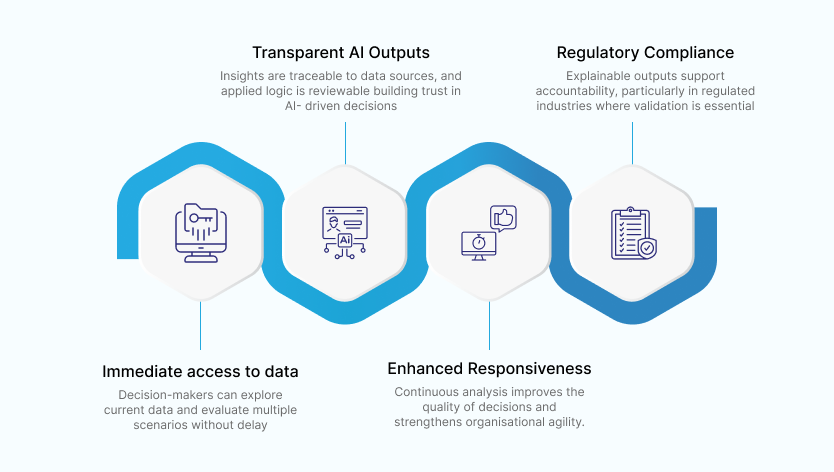
AI Governance and Compliance as Foundational Elements
Governance and compliance no longer remain a choice when AI is increasingly becoming part of enterprise operations. They are essential elements in any intelligent system of decision-making. It requires proper AI governance and compliance systems to make sure that the use of data, model behaviour, and decision outputs does not contradict organisational policies and regulatory requirements.
Qlik addresses these needs by embedding governance into every stage of the data and analytics lifecycle. From data ingestion to model deployment, organisations can enforce access controls, monitor data quality, and maintain detailed records of the data lineage. This integrated approach reduces risk and supports the responsible use of AI in strategic decision-making.
Moreover, governance frameworks enhance the scalability of agentic AI for enterprises. By establishing clear standards and controls, organisations can expand AI adoption without compromising on compliance or operational integrity.
Extending AI Capabilities Through Integration
Modern enterprises operate within complex technology ecosystems that include multiple tools and platforms. To maximise the value of AI, it is essential to enable interoperability across these systems. Qlik helps this through integration capabilities that extend intelligent decision systems beyond its core platform.
By connecting with external AI tools and services, organisations can incorporate Qlik-powered insights into broader workflows. This integration ensures that AI-driven decisions are not confined to a single platform but are embedded across enterprise processes. It also allows organisations to leverage existing investments while improving them with advanced analytics and AI capabilities.
Driving Enterprise Digital Transformation with AI
Enterprise digital transformation with AI is not limited to adopting new technologies. It involves redefining how firms operate, make decisions, and deliver value. Agentic AI, combined with solutions from SquareOne Technologies and Qlik, plays an important role in this transformation by enabling continuous, data-driven decision-making across all levels of the organisation.
With Qlik AI solutions and SquareOne’s expertise in AI orchestration frameworks, enterprises can transition from reactive decision models to proactive and predictive approaches. This shift enhances operational efficiency, increases resource allocation, and supports long-term strategic planning. By embedding intelligence into everyday workflows, organisations can achieve a higher level of agility and resilience.
In Conclusion
Architecting enterprise agentic AI requires a holistic approach that integrates data, analytics, governance, and intelligent automation. Qlik AI solutions enable organisations to build scalable, transparent, and effective decision-support systems that turn insights into actionable strategies. By bridging the gap between data and decision-making, enterprises can unlock new growth opportunities while maintaining strong governance and compliance. Agentic AI represents a pivotal step toward consistent, real-time value across the organisation.
Discover how SquareOne and Qlik can help your business make better, faster decisions.