
How to Construct a Scalable Decision Intelligence Layer for Enterprise Agentic AI
By 2027, AI is expected to transform up to 50% of business decisions through augmentation or automation, signifying a profound shift in how enterprises derive competitive advantages. Against the backdrop of this forecast, the evolution of enterprise decision intelligence from a theoretical construct into a foundational component of modern digital infrastructure is set to become a reality. To achieve agentic AI in the business, leaders will have to move beyond the isolated analytics and automation systems to create a unified decision intelligence environment that will execute realistic, dependable autonomous workflows at scale.
In organisations with enterprise AI solutions, this layer is the point of integration between governance analytics, real-time data integration, and AI orchestration. When SquareOne professionals are left to hold them in their hands by providing them with integrated functionalities within governed analytics, data integration, and AI orchestration, enterprises can now hasten towards the path of reliable autonomy.
The Strategic Importance of a Decision Intelligence Layer
By 2031, projections indicate that the enterprise AI market will expand to $273 billion, with decision intelligence tools scaling quickly together. This projected growth makes the need for structured and scalable decision capabilities increasingly important.
- Traditional decision management systems often depend on fragmented analytics or manual judgment, making it difficult for teams to respond quickly or consistently. Over time, this leads to delays, operational inefficiencies, and decisions that vary across functions.
- A decision intelligence layer changes this dynamic by bringing data and AI together into a unified decision framework. It enables organisations to make decisions that are consistent, repeatable, and aligned across processes rather than isolated within individual teams or systems.
- While conventional analytics focus on explaining what has already happened, advanced decision intelligence goes a step further by turning insights into clear, actionable strategies. These strategies are not static; they are continuously assessed and refined as conditions change.
These strategies can be executed and evaluated in real time. This approach is especially critical for enterprises deploying enterprise agentic AI.
Since decisions can be executed and evaluated in real time, this approach becomes essential for enterprises deploying agentic AI systems. The existence of such systems requires them to be sensitive to their environment, to reason against set goals, and to take actions within governance limits, and therefore, reliable decision intelligence is a necessity.
Core Components of a Decision Intelligence Layer
A scalable decision intelligence architecture must address several core concerns:
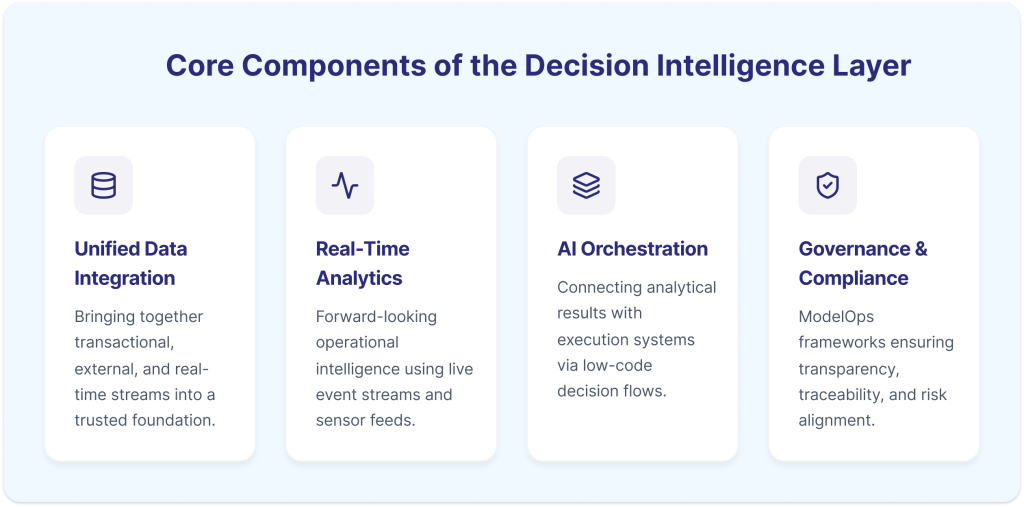
Unified Data Integration and Governance
An effective decision intelligence layer is founded on governed data. This starts with bringing together data from transactional systems, external sources, and real-time streams into a unified, trusted foundation. Strong data integration and governance ensure data stays accurate, traceable, and compliant across the enterprise.
When analytics are governed, decision logic is based on consistent and validated data, allowing AI-driven decisions to be reliable and trustworthy. Without this foundation, agentic AI efforts are more likely to produce inconsistent results, misinterpret signals, and lose stakeholder confidence.
Real-Time Analytics and Operational intelligence
With the implementation of a controlled data foundation, the addition of real-time analytics would provide the opportunity to transition to real-time, forward-looking reporting instead of the previous static one. Live event streams, sensor feeds, and transaction logs feed advanced analytical models that detect patterns, anomalies, and opportunities as they unfold.
This stream of live intelligence empowers enterprise agentic AI systems to act with contextually current information. For example, in supply chain optimisation, real-time demand signals can trigger adaptive procurement decisions or logistic adjustments without manual intervention.
AI Orchestration and Actionable Decision Services
The ultimate purpose of decision intelligence is not only insight but also actionable autonomy. This requires orchestration functions that connect analytical results with execution systems. Microsoft’s Power Platform, including Power Automate and AI Builder, provides a low-code environment for orchestrating decision flows, automating reactions, and embedding AI logic within enterprise workflows.
Orchestration of smart decisions is used to guarantee organised actions in various systems, such as transforming inventory, altering financial forecasts, or initiating communications with customers. The inclusion of AI services in this orchestration layer enables the application of predictive and prescriptive analytics, natural language reasoning, and policy-based execution.
Governance, Explainability, and Compliance
A scalable decision intelligence layer should never compromise on governance. Enterprise AI operations should be transparent and traceable. This holds particularly in agentic AI, whereby AI explores multifaceted workflows on its own. Logging, explanatory frameworks, and rollbacks should be clear without any ambiguity to ensure that decisions are reviewable, validated, and aligned to risk policies.
Frameworks like ModelOps, comprising the lifecycle management of analytical and AI models, are important in this respect. Under the AI governance in the enterprise, there is a need for ModelOps, as they create assurance that the operations of the models will be optimal in production and adhere to the compliance and performance KPIs.
Designing for Scale and Reliability
Scaling intelligent enterprise AI requires architectural foresight characterised by:
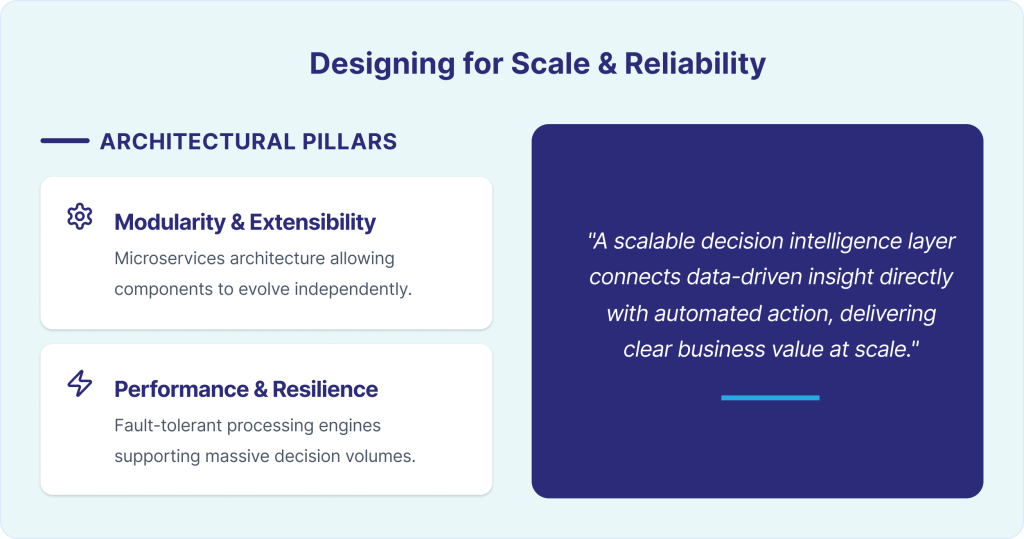
Modularity and Extensibility
The composable architecture or microservices-based architecture enables decision intelligence components to develop independently to facilitate flexibility and scalability in the future. A modular design facilitates integration with next-generation AI models and analytics engines without disruptive architectural overhauls.
Performance, Resilience, and Observability
The decision intelligence layer should have resilient data pipelines, fault-tolerant processing engines, and transparent monitoring dashboards to support hundreds of thousands of autonomous decisions every minute. Observability provides the capacity to measure throughput, accuracy of decision-making, and latency, which are vital in continuous improvement and operational excellence for the stakeholders.
SquareOne as a Strategic Enabler of Decision Intelligence
Advanced analytics and data integration capabilities play a critical role in unifying enterprise data with governance at scale. These systems help organisations eliminate data silos, enforce consistent data definitions, and provide broad access to accurate insights. Together, these capabilities form the analytical backbone of a scalable decision intelligence layer, ensuring the data accuracy and consistency that autonomous systems depend on.
Complementing this analytical foundation are AI services, real-time data processing, and automation orchestration capabilities. Low-code and orchestration systems enable the quick construction, coordination, and scaling of decision flows, integrating AI-driven logic directly into organisational processes. This allows organisations to move efficiently from insight to action.
When these capabilities are combined, decision intelligence systems can be established more quickly and effectively. The integration of governed analytics, real-time data, AI reasoning, and coordinated execution enables organisations to operationalise agentic AI, ensuring decisions are reliable and aligned with business and governance requirements.
In Conclusion: Architecting the Autonomous Enterprise
Developing a scalable decision intelligence layer for enterprise agentic AI is a cross-disciplinary task that needs a unified architectural vision. It demands disciplined data governance, advanced real-time analytics, orchestrated automation flows, and rigorous governance frameworks. When executed effectively, this architecture enables autonomous systems that operate dependably, drive strategic value, and adapt to evolving business conditions.
As organisations deepen their use of AI, the focus shifts from deploying isolated intelligent tools to building robust decision systems that deliver clear business value at scale, connecting data-driven insight directly with automated action.