Intelligent Content and ProcessAutomation in the Age of Agentic AI
Introduction
According to industry research, 80–90% of newly generated enterprise data is unstructured, growing far faster than structured data and largely residing in documents, emails, contracts, images, and records that traditional systems struggle to govern. As organisations accelerate automation and AI adoption, this unstructured content has become both their biggest operational risk and their most valuable untapped asset. The challenge is no longer limited to digitisation. Instead, it is now the transformation of fragmented content into intelligent, governed, and executable enterprise processes.
This change is propelling intelligent process automation, where content, workflows, and decision logic come together. Automation should now be context-aware, accountable, and autonomous in complex enterprises and institutions of the public sector as well. This is where agentic AI automation is reshaping expectations, moving automation from task execution to orchestrating outcomes.
From Content Silos to Executable Intelligence
The main objective of traditional automation projects was specific, structured data and fixed processes. However, contracts, policies, invoices, case files, and correspondence can hardly ever be put into rigid formats. The gap is bridged with intelligent content automation, which combines an AI-guided way of thinking with enterprise-level governance. Smart document processing applications process unstructured data, put it into perspective, and integrate directly into business processes.
Platforms such as our technology partner Hyland’s enterprise content and process management solutions play a critical role in this transformation. By unifying content repositories with workflow intelligence, organisations gain a single operational view of information across departments, systems, and lifecycle stages. When paired with document processing automation, enterprises can reduce manual handling, enforce compliance, and accelerate decision timelines without losing control.
This development is particularly applicable in regulated platforms, where information is not dormant data but a source of legal, financial, and operational authority.
Intelligent Automation Meets Autonomous Decision-Making
The emergence of agentic AI automation establishes a new dimension in enterprise automation. Unlike rule-based systems, agentic models are capable of perceiving context, evaluating alternatives, and taking action within clearly defined governance boundaries.
Within AI business process automation, these systems do more than follow present instructions; they actively coordinate workflows in real time, adapting to operational signals as they arise. Microsoft’s automation and AI services enable this orchestration at scale by connecting intelligent workflows, low-code automation, and AI-driven decision services across enterprise environments.
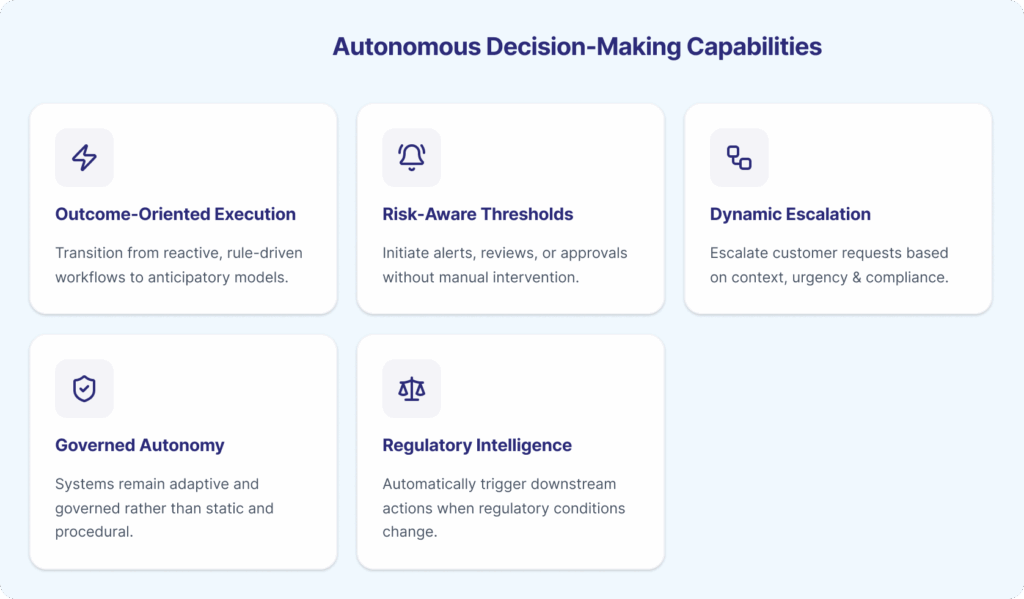
- Insights can be operationalised seamlessly across content, processes, and systems through intelligent automation services.
- Enterprises transition from reactive, rule-driven workflows to anticipatory, outcome-oriented execution models.
- Intelligent document automation can automatically trigger downstream actions when regulatory conditions change.
- Contract risk thresholds can initiate alerts, reviews, or approvals without manual intervention.
- Customer requests can be escalated dynamically based on context, urgency, and compliance requirements.
- Automation becomes adaptive and governed, rather than static and procedural.
Governance as the Foundation of Automation Trust
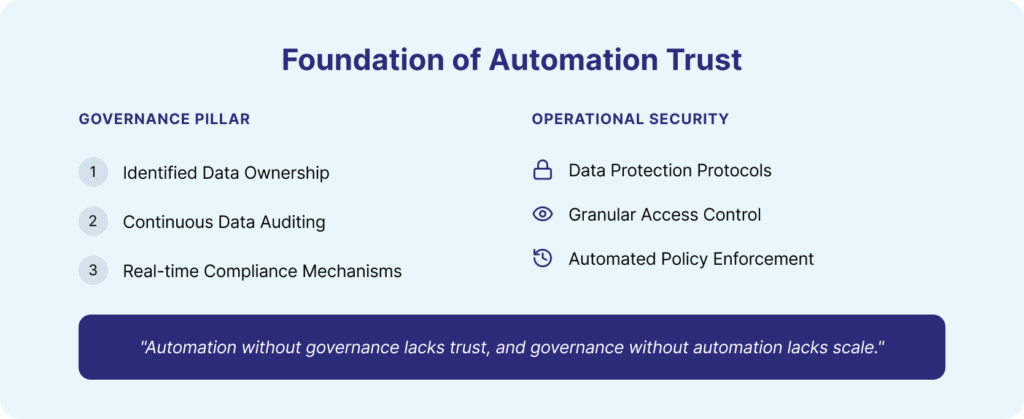
Governance is becoming non-negotiable as automation systems develop an autonomous system. The automation of smart processes should be conducted with well-identified data ownership, data auditing, and compliance mechanisms. In the absence of this foundation, automation increases the risk instead of minimising it.
This feature is especially apparent in the government and the highly regulated sectors, where accountability, transparency, and resilience are strategically important. The automation service models of intelligent processes should incorporate the protection of the data, the access control, and the policy enforcement directly into the workflows.
The convergence of intelligent content automation and AI-driven orchestration enables organisations to enforce governance at the point of action. Content is not only processed faster; it is processed correctly, consistently, and in alignment with regulatory expectations.
Aligning with Smarter Governance Initiatives
Governments and enterprises across the UAE are increasingly viewing automation as a governance enabler, rather than a risk factor, as they prioritise data resilience.
With the focus now on AI-powered governance and interoperability, resilient digital services underscore a critical insight: automation without governance lacks trust, and governance without automation lacks scale. When AI processes are based on robust content foundations and transparent controls, they turn into a strategic resource of transformation for the country and enterprise.
In Conclusion: The Path Forward
The future of automation is not defined by isolated tools but by integrated intelligence. Intelligent document processing solutions, AI business process automation, and intelligent automation services must operate as a cohesive system, capable of understanding content, executing processes, and adapting decisions within governed boundaries.
By combining Hyland’s strength in enterprise content and process management with Microsoft’s AI and automation capabilities, organisations can transform unstructured information into operational clarity. The result is automation that is intelligent, accountable, and resilient by design.
As agentic AI continues to grow, enterprises that invest in governed, content-centric automation today will be best positioned to scale innovation tomorrow, with confidence, control, and trust at the core.