
The Hidden Risks of Delaying Your NDMO P2 Compliance And How to Avoid Them
Introduction
According to Gartner, 87% of chief compliance officers report rising regulatory pressure, signalling that compliance is now central to enterprise trust and value. In Saudi Arabia, Vision 2030 has made data governance institutional, with the National Data Management Office (NDMO) setting the national benchmark for trusted and interoperable data ecosystems. Priority 2 (P2) compliance marks the shift from policy documentation to operational execution.
To accelerate this transition, SquareOne Technologies, in partnership with Edgematics Group, introduced “P2 in a Box”, a fixed-scope, time-bound solution that streamlines NDMO P2 compliance and embeds best practices. This blog examines why delaying P2 compliance is a strategic risk, its hidden organisational impacts, and how structured, data-driven compliance frameworks enable long-term governance resilience.
The Hidden Consequences of Postponing NDMO P2 Compliance
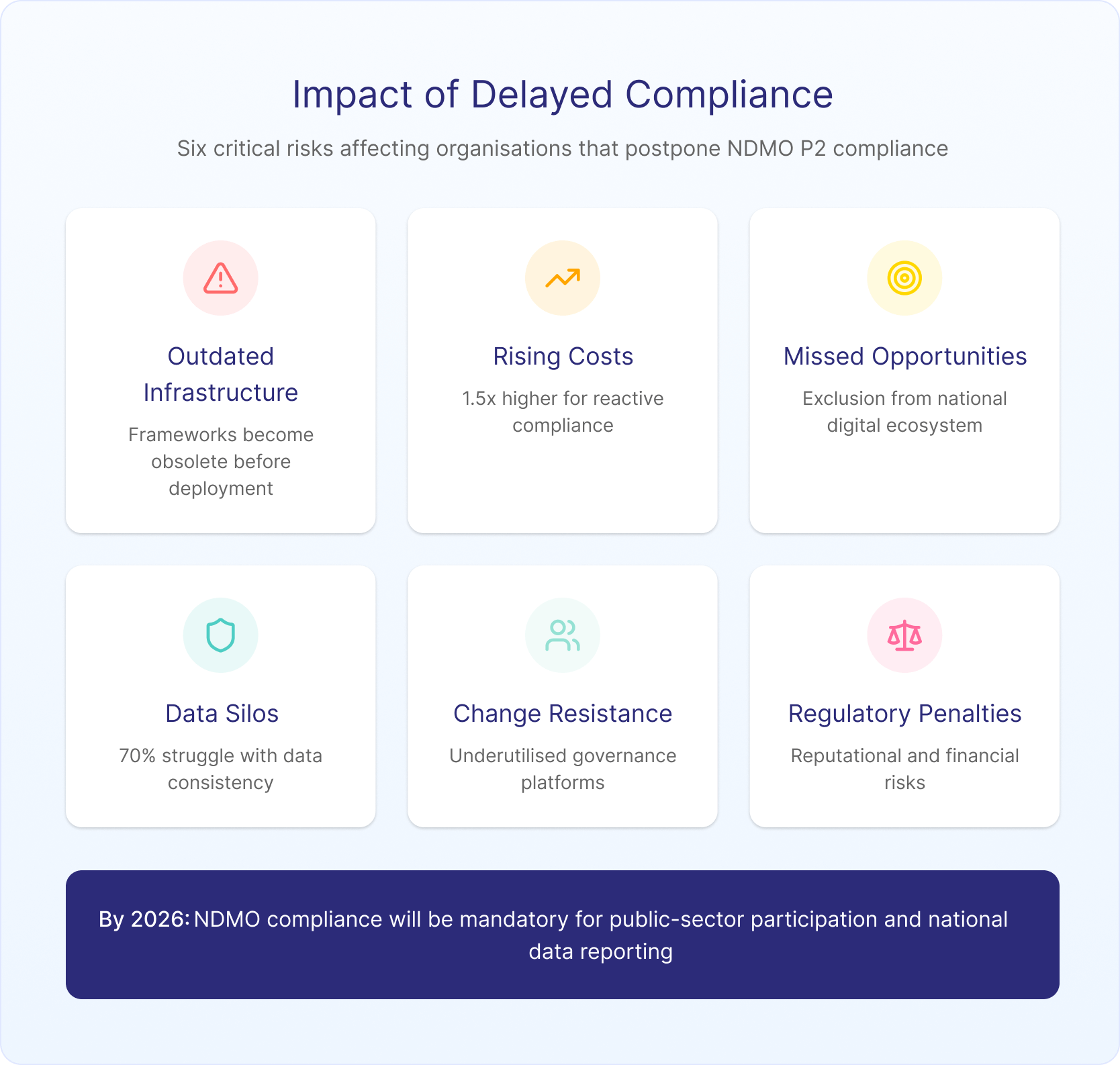
Governance Infrastructure Becomes Outdated Before It Begins
Data governance must evolve as fast as the ecosystem it regulates. Delaying implementation means governance frameworks are outdated the moment they are deployed. By 2026, NDMO compliance will become a mandatory prerequisite for public-sector participation and national data reporting. Late adopters will end up rebuilding entire infrastructures instead of refining them.
Without proactive enterprise compliance risk management, organisations face fragmented repositories, poor lineage visibility, and unreliable data quality controls. These inefficiencies erode trust and prevent leadership from accessing unified insights, leaving enterprises reactive rather than strategic.
Escalating Compliance Costs Outpace Project Budgets
Each month of delay amplifies compliance costs. Legacy systems harden, integrations grow complex, and remediation becomes expensive. McKinsey reports that reactive compliance efforts can cost up to 1.5 times more than structured transformation programmes.
To Saudi organisations operating in line with the 2025–2026 milestones of NDMO, the cost of doing nothing is substantial. Retroactive compliance drives up maintenance costs and drains resources. Regulatory compliance in a business plan mitigates this risk by focusing investments on automation, unified data platforms, and measurable ROI. Proactive compliance not only safeguards capital but also strengthens future readiness.
A structured regulatory compliance in a business plan mitigates this risk, focusing investments on automation, unified data platforms, and predictable ROI. Proactive compliance not only safeguards capital but also strengthens future readiness.
Missed Opportunities for National Digital Engagement
The NDMO P2 compliance serves not as a bureaucratic barrier, but rather as a gateway to the rapidly expanding Saudi Arabian national digital ecosystem. Government offices and large businesses are constructing networks of data that are interconnected to report, provide smart services, and govern AI-powered systems.
Organisations lacking compliance certification risk exclusion due to data integrity or interoperability issues. This limits access to national data initiatives, partnerships, and government procurement opportunities.
Compliant enterprises, by contrast, achieve seamless integration with centralised systems and KlarityONE compliance solutions, enabling collaboration, innovation, and visibility within the Kingdom’s digital transformation roadmap.
Amplified Risk of Data Silos and Trust Deficits
When compliance implementation lags, data silos deepen and organisational trust suffers. Multiple systems operate under conflicting standards for data accuracy, ownership, and privacy. 70% of organisations struggle with cross-functional data consistency, undermining operational decisions and regulatory confidence.
In sectors such as banking, healthcare, energy, and government, these inconsistencies can trigger audit failures, public scrutiny, and even operational penalties.
Implementing NDMO P2 compliance best practices helps establish a single source of truth architecture. Every department and system operates on verified, lineage-tracked data, improving decision accuracy and regulatory alignment.
Change Management Becomes the Afterthought
The greatest threat to compliance success isn’t technology; it’s people. During the “P2 in a Box” webinar, Prem Nair (Country Manager, SquareOne Technologies) and Zaheer Ahmed (Principal Architect, Edgematics Group) emphasised that executive sponsorship, structured training, and employee involvement are vital for sustaining compliance.
Without effective change management, even advanced governance platforms remain underutilised and disconnected from business outcomes. Compliance must become a living culture—embedded in operations, leadership priorities, and decision-making frameworks. Organisations that adopt integrated enterprise risk and compliance management systems encourage ownership, accountability, and collaboration across all levels, ensuring that compliance transformation becomes continuous, not occasional.
Regulatory Penalties and Reputation Risks Intensify
As Vision 2030 gains momentum, non-compliance is no longer an invisible problem. Both NDMO and SDAIA have heightened audit intensity, assessing data transparency and governance maturity across industries.
Non-compliant organisations risk regulatory penalties, limited data privileges, or even exclusion from public-sector opportunities. The reputational damage is not limited to compliance, but it also throws a question mark on the credibility of an organisation in terms of trust, transparency, and national priorities.
Delaying compliance, in the context of the current data economy where information integrity is equated to business credibility, is a disastrous message to compliance for the partners and customers, as well as to the regulators.
How to Avoid the Risks: A Structured Path to P2 Compliance
Avoiding these pitfalls requires a systematic, three-step compliance model that integrates technology, process, and culture.
Adopt a Fixed-Scope, Time-Bound Framework
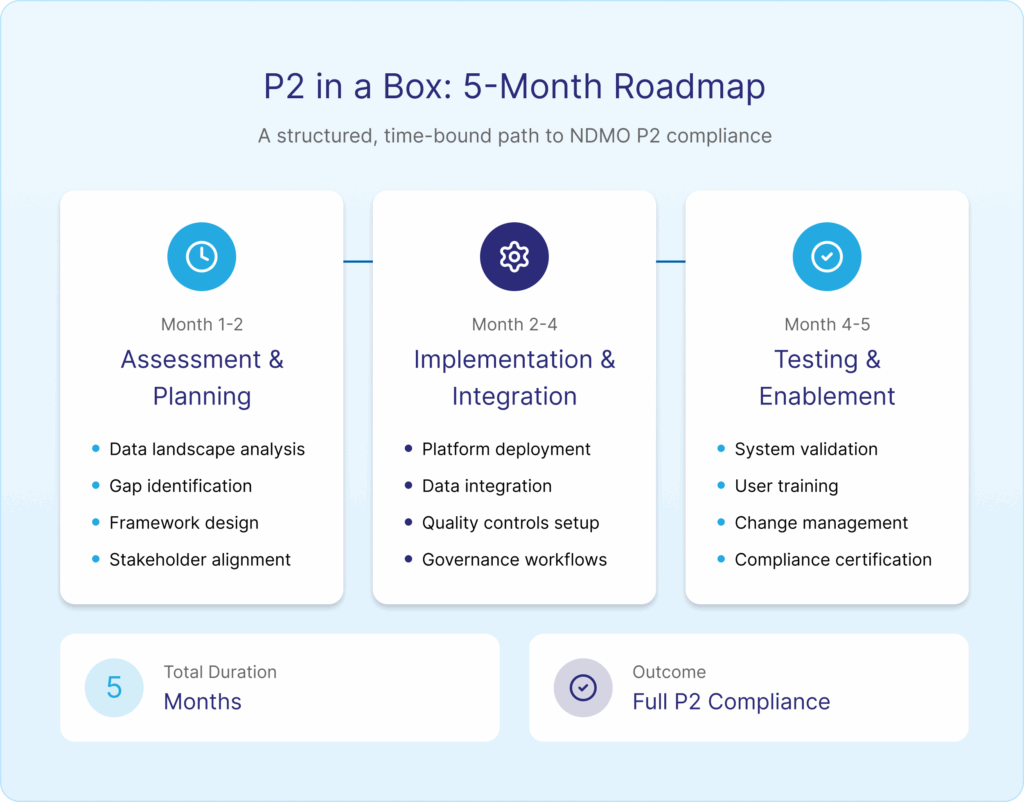
Frameworks like “P2 in a Box” show that enterprise compliance risk management doesn’t need to be open-ended. A five-month fixed-scope plan covering data integration, master data management, and governance dashboards delivers structured outcomes within defined timelines.
This approach ensures transparency, accountability, and budget predictability, key aspects of any sound regulatory compliance in a business plan.
Select a Unified Data Platform
Platforms such as Semarchy, recognised by Gartner, unify governance, data quality, and master data management. These KlarityONE compliance solutions simplify compliance by ensuring traceability, reducing redundancy, and supporting hybrid deployments that balance on-premise and cloud environments.
Such unified systems enable scalability and real-time monitoring, helping organisations meet NDMO P2 benchmarks without operational disruption.
Integrate Change Management
Sustainable compliance requires leadership alignment and employee participation. Establish governance councils, track adoption KPIs, and maintain transparent reporting structures. When teams understand their role in data ownership, compliance transforms from an obligation to shared accountability.
This cultural shift turns NDMO adherence into a long-term advantage, improving data quality, operational agility, and organisational trust.
Conclusion
NDMO P2 compliance is now a strategic cornerstone of Saudi Arabia’s Vision 2030. Any delays can only augment financial, operational, and reputational risks. SquareOne Technologies addresses this gap by offering a five-month “P2 in a Box” model, supported by KlarityONE compliance solutions, which help enterprises accelerate their readiness, improve governance, and achieve lasting resilience to regulations.