How Can Enterprises Build Secure,Governed Agentic AI Pipelines at Scale?
Enterprises have spent the last decade learning how to govern data, applications, and users. They are now confronted with a new reality: systems that do not merely process information but act on it. Agentic AI systems read documents, verify identities, access enterprise applications, trigger workflows, and make decisions that carry operational and regulatory consequences.
Yet, recent research shows 95% of executives report AI-related mishaps, with only 2% of organisations meeting responsible AI standards, highlighting a stark governance gap. At this point, AI is no longer a tool that produces outputs. It becomes an operational participant inside the organisation’s control environment.
To safely deploy such systems at scale, enterprises must design agentic AI pipelines where document authenticity verification, AI identity verification, and AI-based compliance are engineered directly into the pipeline architecture. This is not an afterthought for compliance teams. Instead, it is now a foundational concern for architects, security leaders, and technology strategists.
This blog is an exploration of how enterprises can design agentic AI pipelines that embed governance, identity assurance, document authenticity validation, and policy enforcement directly into their architecture to enable compliant, scalable autonomous AI.
Agentic AI Pipelines as Enterprise Operational Infrastructure
In traditional AI workflows, inference comes through when an input is processed, an output is produced, and a human agent decides what to do next. Agentic systems, in contrast, remove the human pause and make the output actionable. This shift turns the pipeline into operational infrastructure. It must now answer questions typically reserved for enterprise systems, such as:
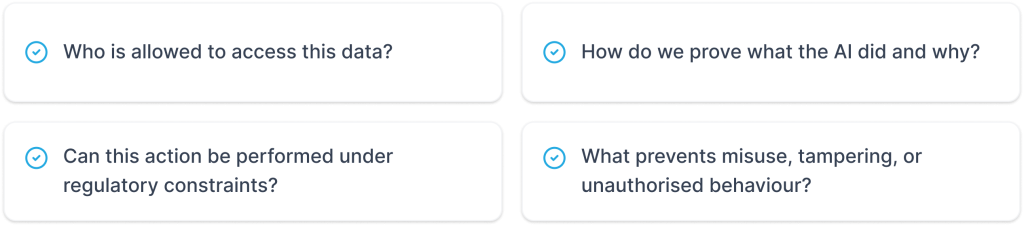
This is where agentic AI governance becomes essential. The pipeline must operate as a controlled environment in which every step from data ingestion to final action is continuously governed under clear AI compliance and governance controls.
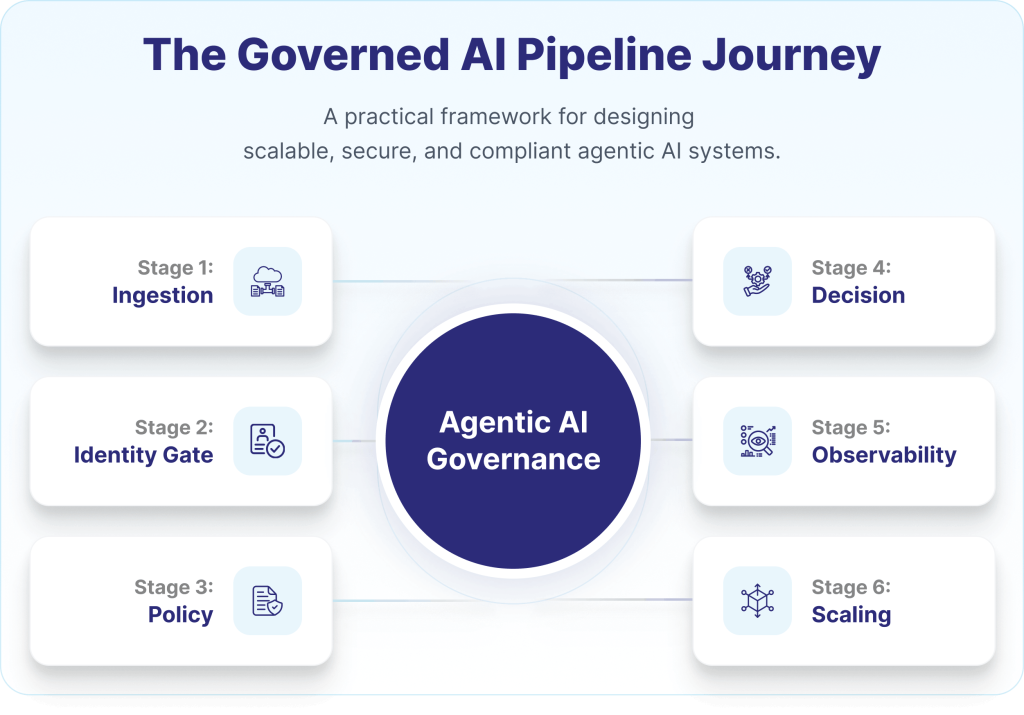
Stage 1 — Ingestion: Document Authenticity Verification as the First Gate
Every agentic AI pipeline begins with data and document ingestion. Contracts, certificates, IDs, forms, medical records, financial statements, and regulatory artefacts enter the system. If these inputs enter unverified, the entire pipeline is compromised.
… and here is where document authenticity verification becomes the first architectural control point. Before an agent reads or reasons, the pipeline must establish whether the artefact itself is trustworthy.
This involves carrying out:
- Structural and metadata validation
- Tamper detection and forgery analysis
- Verification against issuing authorities or trusted registries
- Timestamp and provenance checks
Stage 2 — Identity Gate: AI Identity Verification Before System Access
Once trusted data enters the system, the next control layer addresses identity. Before an agent interacts with enterprise applications or acts on behalf of a user, AI identity verification and AI-powered ID verification must be triggered.
These ensure that:
- User credentials are validated against enterprise identity systems
- Identity documents are cross-checked with biometric or behavioural signals
- Access rights align with role and regulatory requirements
- Suspicious patterns or anomalies are detected in real time
Stage 3 — Policy Enforcement: AI for Real-Time Regulatory Compliance
Data Residency Rules
Approval Workflows
Encryption Standards
Risk Thresholds
Once inputs are trusted and identities are verified, the pipeline moves to the decision layer. This is where policy stops being documentation and starts operating as code. Here, regulatory compliance is not monitored after the fact. It is enforced in real-time through defined policy enforcement points. Access to sensitive datasets is automatically restricted. Actions that could breach data residency rules are prevented. High-risk operations are paused for additional approvals. Non-compliant paths are blocked before they can be executed.
This is also where agentic AI governance becomes practical and measurable. The system does not rely on the agent to “do the right thing”. The pipeline is designed so that the wrong thing simply cannot happen.
Stage 4 — Decision and Action: AI-Based Compliance Embedded in Behaviour
Once policy constraints are satisfied, the agent can perform its intended task, like reading, deciding, updating records, initiating workflows, or triggering downstream systems.
At this stage, AI-based compliance ensures that:
- Actions remain within the authorised scope
- Decisions are recorded with contextual metadata
- The reasoning path is preserved for traceability
- No action bypasses governance checkpoints
Stage 5 — Observability: Proving AI Compliance and Governance
In agentic AI systems, governance cannot rely on policy alone. It must be observable, traceable, and defensible. An effective observability layer records the full decision trail across the pipeline, which documents passed authenticity checks, which identities were verified, which compliance policies were invoked, and the rationale behind every decision. It also captures the actions executed and the entity responsible for them.
This creates a reliable audit trail that regulators, auditors, and risk teams can interrogate with confidence. Governance, therefore, moves from being a stated intent to a demonstrable, evidence-backed capability.
Stage 6 — Scaling Agentic AI Pipelines Without Scaling Risk
As enterprises deploy multiple agents across departments, governance must remain consistent. Reusable pipeline components for:
- Document authenticity verification
- AI-powered ID verification
- Policy enforcement
- Audit logging
Engineering Agentic AI Governance into the Architecture
A common mistake is treating governance as documentation. In agentic systems, governance must be engineered.
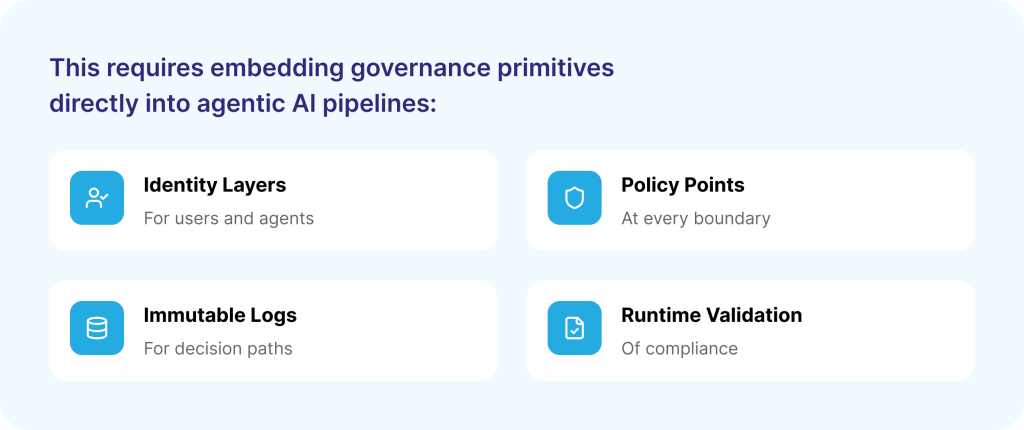
The practical outcome is straightforward: no agent decision occurs without passing through governance checkpoints. The pipeline itself becomes the enforcement mechanism for AI compliance and governance.
The Role of AI Governance Services in Enterprise Implementation
Building structured, compliant AI pipelines is not just a technical exercise, as it demands specialised governance thinking. That is where AI governance services make a real difference.
They help enterprises put the right controls in place from the start: verifying documents as they enter the system, strengthening access with AI-led identity checks, embedding regulatory compliance directly into policy layers, and creating full observability across the pipeline.
In essence, these services turn regulatory intent into a working architecture that teams can trust every day.
SquareOne: Your Go-To Tech Partner in Saudi Arabia
As organisations adopt agentic AI, the real priority shifts from intelligence to trust and control. SquareOne enables enterprises in Saudi Arabia to build AI pipelines where governance is embedded from the start. From document authenticity and AI-led identity checks to policy-driven compliance at decision points, every layer is secured. End-to-end observability ensures every action, decision, and access point is traceable and auditable. The result is agentic AI that is intelligent, compliant, and secure by design from day one.
Conclusion
The maturity of an agentic system is not measured by the sophistication of its model but by the strength of the pipeline that governs how it acts.
When agentic AI governance, document authenticity verification, AI identity verification, and AI-based compliance are engineered into agentic AI pipelines, enterprises create systems that can operate autonomously without creating unmanaged risk.
At enterprise scale, trust is not built through capability alone. It is built through control, accountability, and demonstrable governance, all of which reside in the pipeline.
Design your agentic AI pipelines with governance at the core with SquareOne.
Make compliance, identity, and control part of your architecture from Day One.