Agentic AI vs Generative AI: Which Should Enterprises Be Investing In?
Introduction
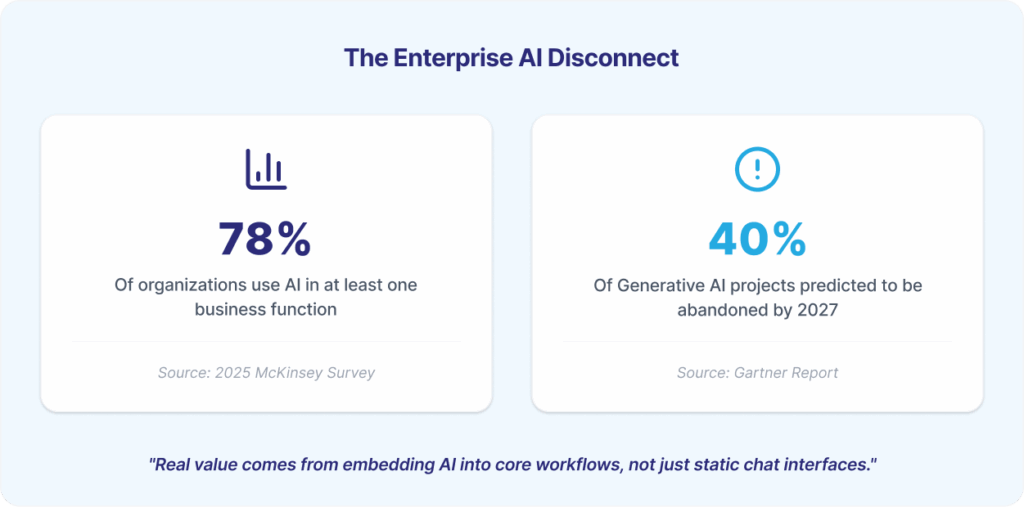
A 2025 McKinsey survey has found that despite nearly 78% of organisations now using AI in at least one business function, most report limited measurable enterprise impact. This disconnect highlights, albeit jarringly, the fact that real operational and governance value comes from embedding AI into core workflows and decision‑making processes.
Regardless of the potential, investments in enterprise AI persistently centre on Generative AI tools, unaware of the definite business outcomes. As governments and enterprises adopt AI-driven digital transformation initiatives, the focus is shifting to whether AI delivers long-term ROI, at what scale, and what it takes to enable responsible and scalable use.
Here is where the agentic AI vs generative AI debate enters the conversation. While generative AI has captured attention by producing content creation and conversational interfaces, agentic AI represents more than a strategic cycle of perceiving, planning, and executing across systems. In this blog, we understand where enterprises should focus their investments to drive measurable impact.
Understanding Generative AI in the Enterprise Context
Generative AI is better at creating texts, codes, pictures, and summaries that are based on patterns learnt in huge datasets. It is used in enterprise settings in productivity applications, including report writing, speeding up customer service interactions, or aiding knowledge workers. These features provide instant visibility and marginal efficiency benefits’ reasons why they are quickly adopted.
However, generative AI operates in isolation from enterprise decision loops. It responds to prompts instead of aligning with organisational objectives. A Gartner report has cautioned that by 2027, over 40% of generative AI projects will be abandoned due to escalating costs, unclear value realisation, or governance concerns.
Without strong data foundations and process integration, GenAI remains a tactical improvement rather than a tremendous transformation. This limitation becomes especially pronounced in regulated environments such as government, banking, and healthcare, where trust, auditability, and outcome ownership are non-negotiable.
Why Agentic AI Changes the Equation
Agentic AI goes beyond content generation by enabling goal-orientated action across enterprise systems. These systems are built to understand context, make decisions, trigger workflows, and adapt based on outcomes.
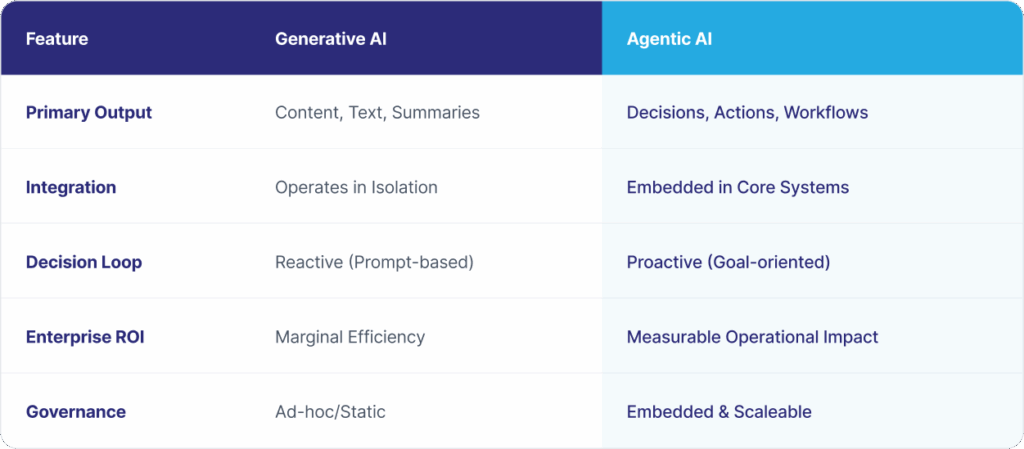
- Common agentic AI use cases include automated compliance monitoring, intelligent case management, predictive service delivery, and cross-department workflow orchestration. These applications directly support enterprise KPIs such as service reliability, cost optimisation, and risk mitigation.
- Agentic AI relies on trusted data, real-time analytics, and embedded governance to operate responsibly.
- Many AI strategies fail at this stage due to fragmented data architectures and the absence of decision intelligence layers.
Without these foundations, agentic AI cannot scale or deliver consistent, confident outcomes.
Where Platforms Matter: Turning Agentic AI into Enterprise Reality
Real enterprise value is realised when Agentic AI and Generative AI are implemented on operations that can unify data, decision intelligence, automation, and governance at scale. This is where SquareOne plays a critical role, helping organisations identify, evaluate, and integrate the right technology partners aligned to their transformation and governance objectives.
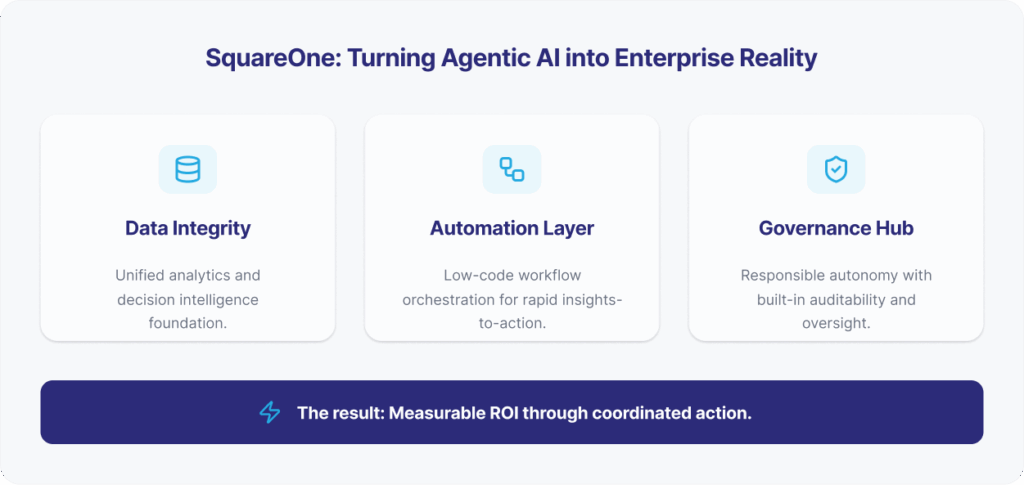
- We provide the analytics and decision intelligence foundation that enables Agentic AI to operate on trusted, governed, real-time data. Autonomous systems will be unable to make sound decisions and fulfill regulatory needs without credible information and data integrity.
- This base is also accelerated by our platform, which supports low-code automation and workflow orchestration to help enterprises transform insights into action in a short period without having to invest engineering resources in it, a capability that is particularly valuable in the public sector and regulated settings that require agility in addition to control.
- An enterprise-grade agentic and conversational AI platform completes the ecosystem by enabling responsible autonomy. It supports the design, deployment, and governance of intelligent agents that can reason, act, and collaborate across systems, with built-in explainability, auditability, and human oversight.
Development of analytics, automation, and agent orchestration as a single system forms a scalable base of AI, which is a quantifiable business outcome, not an experiment.
Implications for Public Sector and Governance Leaders
The shift is especially relevant when it comes to government-led digital projects. As highlighted at the recently concluded Government Data Innovation & Governance Summit 2026 in Abu Dhabi, data resilience, regulatory agility, and AI-powered insights are now central to national digital strategies.
Agentic AI enables governments to operationalise policy through intelligent systems that can monitor, adapt, and respond in real time while maintaining transparency and accountability.
- Growing focus on predictive governance and proactive decision-making
- Increased emphasis on secure, cross-government data sharing
- Expansion of AI-enabled public services driven by real-time insights
- Rising expectations for transparency, auditability, and public trust




In conclusion: What Enterprises Should Invest In
Enterprise AI is moving beyond experimentation toward registering measurable impact. While generative AI has improved content creation and individual productivity, agentic AI is enabling organisations to embed decision-making directly into operations and deliver results at scale. For governments and regulated enterprises, this shift is critical to achieving resilient, transparent, and responsive digital operations.
Real value, however, depends on implementation. AI initiatives must be supported by strong data foundations, decision intelligence, and automation to remain governed, explainable, and aligned with public and business objectives. The future may not be defined by agentic AI vs gen AI, but a considered integration of both can enable enterprises to convert insights into coordinated, outcome-driven action. Firms that invest in this direction will best position themselves to realise perpetual ROI on AI-driven digital transformation.