From Policy to Proof: How Can Saudi Enterprises Meet Evidence-Driven Document Management Compliance Mandates?
What happens when an auditor asks for evidence, and your team needs three days to find it?
For Saudi organisations, compliance is increasingly becoming having more than just policies in place. Instead, they are now required to demonstrate that –
- Requirements are being implemented
- Responsibilities are being assigned
- Control measures are in place and are being followed, and
- Evidence can be produced when required
This comes in the wake of NDMO and other national governance and assessment frameworks placing immense emphasis on documented requirements, implementation, and supporting evidence. Different frameworks now also assess different dimensions of organisational maturity, data governance, digital transformation, and records management.
For enterprise leaders, this raises a more important question than whether policies exist: can your organisation produce the right evidence, from the right records, when it is required?
The answer starts with how information is governed throughout its lifecycle and how requirements are connected to everyday work.
Through this blog, we explore how Saudi enterprises can meet evolving compliance requirements that go beyond documented policies, demanding demonstrable, traceable, and audit-ready evidence supported by governed document and information management.
The Evidence Gap Is an Information Management Problem
Most organisations already have policies in place related to retention, access, records management, and data governance. The difficulty arises when those policies need to be demonstrated in practice.
Consider a document named “Project Contract.pdf.”
A records management team may need to establish its retention period and disposal requirements. A data governance team may need to determine ownership, personal data exposure, and access requirements. A business or digital governance team may need to demonstrate how the document was processed, approved, and controlled.
The document is the same. The governance requirements, however, are not.
Document classification and data classification serve different governance purposes and should not be treated as interchangeable. Organisations need to understand the information they hold, how they should be governing it, who is responsible for it, and what evidence exists across its lifecycle.
When information is spread across repositories and processes, producing evidence becomes a manual exercise. Teams spend time searching, validating and assembling records instead of generating evidence as part of normal operations.
The goal, therefore, is not simply to create more policies. Au contraire, it is to make the application of those policies traceable.
From Requirement to Evidence
The strongest compliance model connects a requirement to the work needed to implement it.
A requirement should have a clear owner, a defined action, a deadline where relevant, an approval or review step, and a record of the evidence produced. Once these elements are connected, the organisation can “see” not only what a policy requires, but how that requirement is being executed.
This changes the role of compliance.
Instead of collecting evidence at the end of an assessment cycle, organisations can build evidence into daily processes. A completed task can produce an evidence record. An approval can create an auditable event. A controlled document can retain its version history. A management dashboard can show progress, gaps, and outstanding actions.
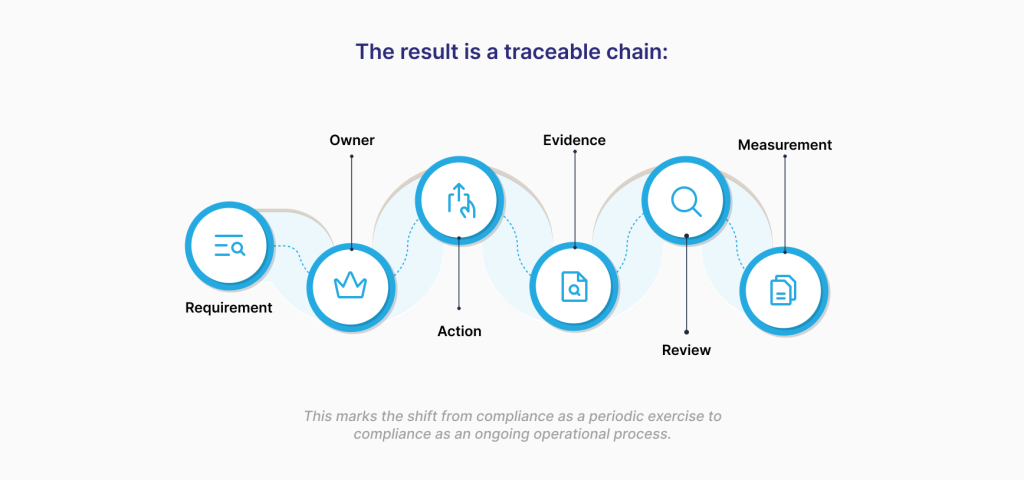
Achieving this requires connecting regulatory requirements to clearly defined responsibilities, operational workflows, documented evidence, approvals, and management reporting, ensuring compliance is continuously demonstrated rather than evidence being collected only during audits.
Building Evidence into the Records Lifecycle
Evidence-driven compliance starts by embedding governance into the way records are handled from the point they enter the organisation to the point they are disposed off with.
1. Capture with defined controls
The first opportunity to establish control is “at capture.”
Documents entering the system can pass through defined quality and capture processes before becoming governed records. This helps improve the consistency of information entering the enterprise environment and creates the basis for subsequent classification, indexing and control.
2. Index information for retrieval and governance
Once captured, records need structured indexing and metadata.
This allows organisations to identify information based on its business and governance context rather than treating documents as isolated files. It also makes relevant records easier to retrieve when evidence is required.
SquareOne’s records model specifically connects document types and metadata with classification, retention policies and subsequent actions.
3. Connect physical and digital records
Digital transformation does not remove the need to manage physical records, particularly for large organisations with established paper archives.
A controlled physical-to-digital connection can link a paper record to its digital counterpart through a barcode, allowing the organisation to track the relationship between both records.
This creates a more complete view of the information lifecycle instead of maintaining separate physical and digital silos. The SquareOne team presents digitisation, barcode linkage, indexing and classification as connected stages within the records lifecycle.
4. Apply retention and controlled disposal
Records also need to be managed at the end of their lifecycle.
Retention rules should determine how long information needs to be maintained, while controlled disposal ensures that records are not retained or destroyed arbitrarily. Where a legal hold or other control applies, disposal must also be appropriately restricted.
The ability to demonstrate these actions is as important as performing them. A documented disposition record can become part of the evidence trail available for review.
5. Make governed information easier to use
Governed information only creates value when people can find and use it.
AI-assisted search, extraction, and analysis can reduce the effort required to locate relevant information and work with enterprise records.
The purpose of AI here is specific: make governed enterprise information easier and faster to access without removing the controls around it.
This is consistent with SquareOne’s AI positioning, where AI is presented as operating over organisational information within user permissions, with human approval remaining part of the process.
The Real Shift: From Periodic Compliance to Continuous Readiness
When these controls operate together, compliance becomes part of the information lifecycle rather than an activity that starts when an audit begins.

That distinction matters.
A governed records environment can give compliance, data and business teams greater visibility into where information resides, how it is being managed, who is responsible for the activity, and what evidence can be produced.
The organisation can also see gaps before an assessment rather than discovering them when an auditor asks for evidence.
This can reduce the effort involved in responding to audits while giving leadership a clearer view of compliance status, outstanding actions and areas requiring attention.
SquareOne makes the same distinction by positioning continuous readiness around evidence generated through daily work rather than evidence assembled only when an assessment is approaching.
The Solution Must Fit the Organisation
There is no single document management model that will work identically across every Saudi organisation.
A municipality managing large physical archives has different requirements from a university managing institutional policies. A regulated enterprise may have different retention, ownership, access and information governance requirements again.
This is where a prescriptive approach matters.
Rather than starting with a technology and asking where it can be deployed, organisations can start with the regulatory requirements, industry context, information environment and specific evidence gaps they need to address.
The technology can then be configured around that requirement. Rather than adopting AI capabilities in isolation, enterprises can assess how they fit existing information governance, compliance requirements, business processes and risk controls.
This is also where industry context matters.
A municipality may prioritise physical archive digitisation, classification and digital organisational memory. A university may need stronger connections between policies, assignments, evidence and performance monitoring. A regulated enterprise may place greater emphasis on access, retention, approvals, auditability and controlled information sharing.

What the ONVISION Demonstrates
ONVISION brings these elements together in a common operating environment for documents, records, governance, compliance, processes, reporting and AI-assisted information access.
The important point is not the individual capability. It is the connection between them.
A requirement can be mapped to a policy or specification. That requirement can be assigned to an owner with a deadline and workflow. The resulting activity can generate evidence, retain its approval and version history, and feed into reporting and management visibility.
This creates a practical connection between what the organisation is required to do, what people actually do, and what the organisation can prove.
This model works by turning requirements into executable processes, daily work generating evidence, and management dashboards surfacing compliance status and gaps.
The records lifecycle supports the same principle across physical and digital records, from digitisation and indexing through retention and documented disposition.
What Examples Show
ONVISION was illustrated through different organisational contexts.
At Riyadh Municipality, the focus included digitising paper archives and creating a more accessible, governed digital information environment. The example also demonstrated capabilities around intelligent search, content extraction, version history, rights and retention controls.
At King Saud University, the focus moved towards plan execution, task ownership, evidence submission and performance monitoring. The example showed how responsibilities and evidence can be connected to ongoing execution rather than assembled separately for an assessment.
These examples demonstrate why the same governance model cannot simply be copied from one organisation to another. The underlying framework can remain consistent, while the information, workflows, responsibilities and evidence requirements are shaped around the organisation.
Why This Matters for AI Readiness
Evidence-driven information management also creates the foundation enterprises need as they introduce AI into business processes.
AI systems need access to relevant and trusted enterprise information. Enterprises also need to understand where that information comes from, what controls apply to it, and how people remain accountable for AI-enabled decisions and actions.
As AI moves into operational workflows, enterprise AI monitoring solutions can be considered where organisations need visibility into AI-enabled processes and operational behaviour.
This is different from information governance itself. Monitoring can show what an AI-enabled process is doing, while governance determines the policies, permissions, controls and accountability around its use.
For organisations expanding their AI capabilities, AI lifecycle management solutions can support a broader framework for introducing, governing, monitoring and improving AI-enabled applications over time.
For more advanced Generative AI environments, LLMOps solutions may become relevant when enterprises move from experimentation into the operational management of large language model applications.
This is a later layer of the AI journey, not a substitute for the governed information foundation underneath it.

Why This Matters for AI Readiness
The relationship between document management and AI is, therefore, not simply about adding an AI assistant to a repository.
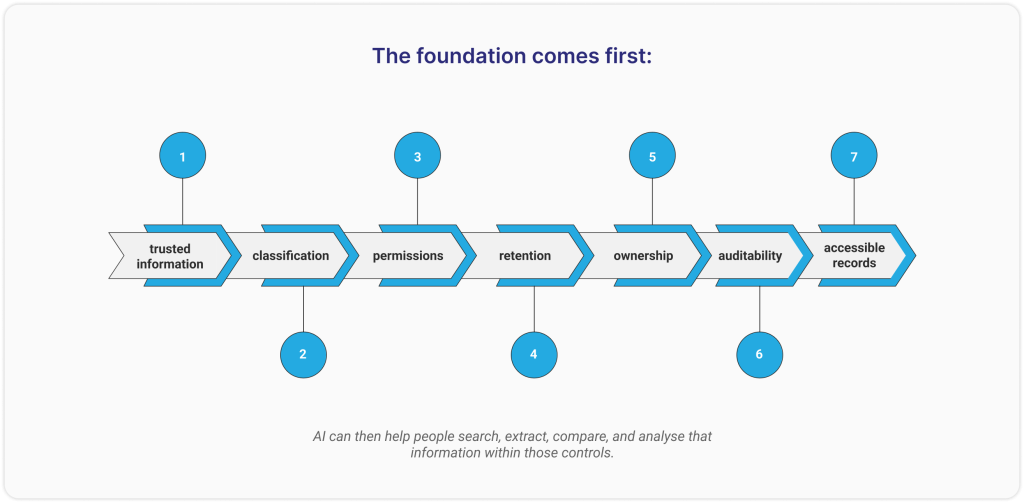
AI can then help people search, extract, compare, and analyse that information within those controls.
As organisations move towards production AI, LLMOps solutions can support the operational layer around large language model applications, while AI lifecycle management solutions can provide a broader framework for managing AI capabilities over time.
Where organisations deploy AI-enabled workflows at scale, enterprise AI monitoring solutions can provide additional visibility into how those workflows operate.
The objective is not to automate governance but to make governed information more usable while keeping human accountability and organisational controls in place.
This distinction is important because the AI proposition is governance-led: the assistant works with organisational information within permissions, while final approval remains with the authorised human user.
A Practical Path from Assessment to Proof
Building this capability does not have to begin with a large transformation programme.
A more controlled starting point is to assess the current information and records environment, identify where evidence gaps exist, and select one priority domain or evidence chain that can demonstrate the value of the solution.
A focused proof of concept can then test the required processes, controls and technology within the organisation’s actual operating environment.
This can include defining the relevant requirements, assigning ownership, establishing the evidence expected, testing the workflow and measuring the resulting gaps or outcomes.
Where AI is part of the target environment, the same exercise can assess how AI lifecycle management solutions fit alongside existing information and governance controls.
If the use case later requires production management of large language model applications, LLMOps solutions can be considered as part of that operational layer.
For AI-enabled processes, enterprise AI monitoring solutions can also be assessed based on what needs to be monitored, who should have visibility, and how issues should be reviewed or escalated.
This method helps reduce uncertainty before wider implementation and gives enterprise leaders a clearer view of what needs to change, where the technology fits, and what outcomes can be achieved.
From Policy to Proof with SquareOne
SquareOne takes a prescriptive, industry-led approach towards helping Saudi organisations connect regulatory requirements with the processes, ownership and evidence needed to demonstrate compliance. It brings together document and records management, knowledge management, and purposeful AI capabilities around the organisation’s specific information and governance requirements.
As enterprises move towards AI-enabled operations, AI lifecycle management solutions, LLMOps solutions and enterprise AI monitoring solutions can extend this foundation into governed AI adoption. The starting point remains the same: trusted, structured and traceable enterprise information.
Summary
Compliance readiness is not built when an assessment begins. It is built through everyday processes that create, govern and preserve evidence as work happens.
For Saudi enterprises, the shift from policy to proof means creating an information environment where requirements are actionable, evidence is traceable, and gaps are visible before they become audit problems.
Identify your evidence gaps and build a focused proof of concept now!