Solving Enterprise Data Integration Challenges: From ETL and EDI to Analytics-Ready, Integrated Data Systems
Enterprises that build reusable, scalable data capabilities can reduce the cost of delivering analytics solutions by 30 to 40% compared to developing separate pipelines for each use case. This highlights the direct impact of integrated data architectures in lowering redundancy, strengthening governance, and improving the overall efficiency of enterprise data integration.
Enterprises deploy multiple tools for ETL, EDI, APIs, and analytics, yet often struggle to turn them into reliable, analytics-ready data. As transformation initiatives grow across finance, operations, and customer platforms, gaps between systems, repeated data movement, and uneven governance practices begin to weaken confidence in reporting and insights. Addressing enterprise data integration challenges is now a strategic priority directly linked to performance, control, and risk management.
The Complexity Behind Modern Data Integration
Most organisations operate a mix of legacy systems, SaaS platforms, partner networks, and cloud data environments. Over time, integration layers evolve in silos. ETL tools work with structured information in core systems, EDI platforms with partner dealings, and analytics departments create individual pipelines to assist reporting. While each component may function independently, the absence of architectural cohesion creates operational friction.
These data integration challenges and solutions typically surface in three areas: duplicated transformation logic, inconsistent data definitions, and limited scalability. Every new analytics or AI initiative requires rework because foundational integration patterns were not designed for reuse. Instead of enabling agility, integration becomes a bottleneck.
Rethinking ETL in a Cloud-Centric Enterprise
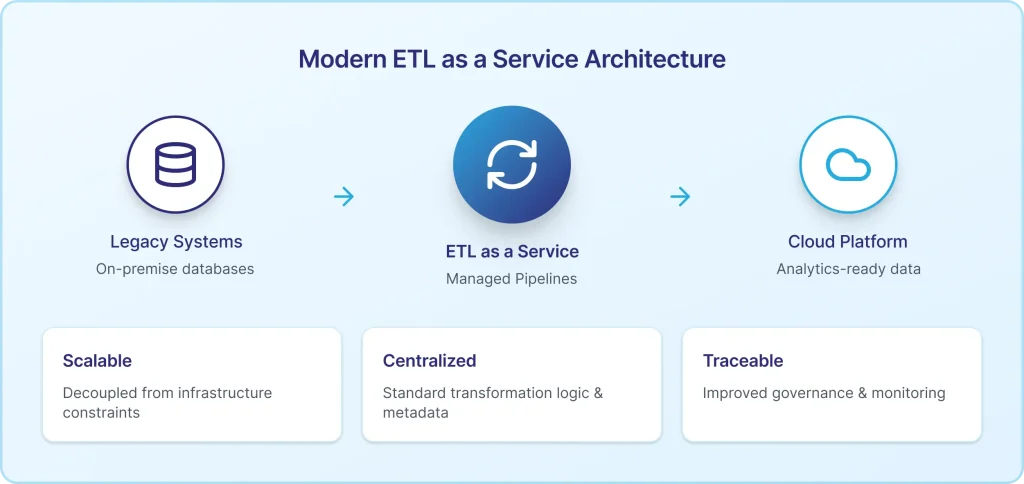
Traditional ETL processes were built for static data warehouses and predictable batch workloads. Today’s enterprise requires near real-time synchronisation across cloud and on-premise systems. This is where ETL as a service is gaining traction.
ETL as a service decouples transformation logic from infrastructure constraints, offering scalable, managed pipelines that support structured and semi-structured data. By centralising transformation standards and metadata management, organisations reduce redundancy and improve traceability. More importantly, they align ETL design with broader data integration and analytics objectives rather than treating it as a back-office utility.
However, modernising ETL alone does not resolve integration fragmentation. It must be embedded within a unified integration strategy.
Strengthening EDI B2B Integration for Ecosystem Resilience
Enterprise integration extends beyond internal systems to the broader business ecosystem, where partner networks, suppliers, logistics providers, and financial institutions depend on reliable EDI B2B integration.
- Many organisations operate standalone EDI gateways with limited visibility into downstream analytics environments.
- Disconnected EDI data flows often require secondary transformation before becoming analytics-ready.
- This duplication increases latency, operational complexity, and compliance risk.
- Integrating EDI pipelines directly into the enterprise data framework enables transactional data to support forecasting, supply chain visibility, and financial analytics in real time.
- A cohesive integration strategy harmonises ETL, APIs, and EDI under shared governance policies, standardised data models, and unified monitoring frameworks.
Building an Integrated Data Warehouse Strategy
An integrated data warehouse remains central to enterprise reporting and advanced analytics. According to McKinsey & Company, organisations that effectively harness analytics are 2.6 times more likely to achieve higher ROI and are significantly more likely to outperform competitors in profitability and growth. The differentiator is not the warehouse itself but the quality and consistency of the integrated data feeding it.
An integrated data warehouse design demands canonical data models, standardised metadata, and ownership. Rather than allowing business units to create parallel marts with inconsistent definitions, enterprises must define enterprise-wide integration principles. This reduces reconciliation efforts and ensures analytics models operate on governed, consistent datasets.
When data integration and analytics are architected together, AI initiatives no longer depend on fragile, one-off pipelines.
Moving Towards a Cohesive Enterprise Integration Strategy
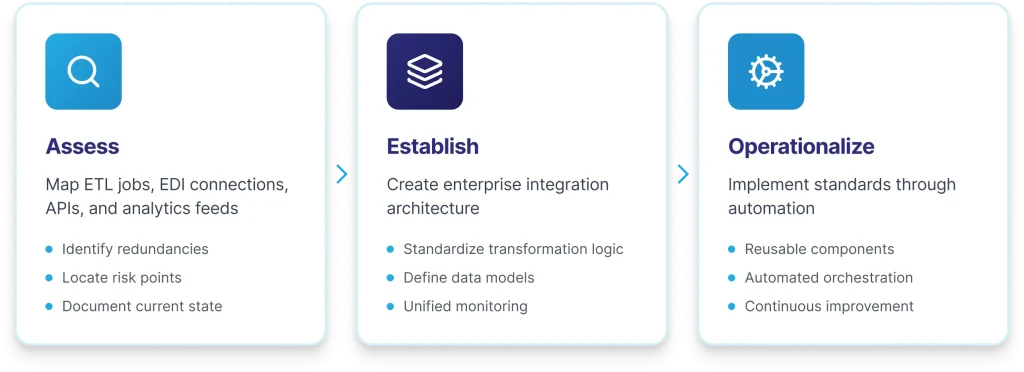
Transitioning from fragmented tools to a cohesive integration framework requires deliberate governance and architectural alignment. Leading organisations approach this transformation in phases:
Transitioning from fragmented tools to a cohesive integration framework requires deliberate governance and architectural alignment. Leading organisations approach this transformation in phases:
- Assess existing integration assets, mapping ETL jobs, EDI connections, APIs, and analytics feeds to identify redundancies and risk points.
- Establish an enterprise integration architecture that standardises transformation logic, data models, and monitoring across platforms.
- Operationalise these standards through automation, reusable components, and integration orchestration.
This is where specialised data integration consulting services add measurable value. Experienced advisors bring cross-industry patterns, governance frameworks, and migration roadmaps that minimise disruption while modernising integration capabilities.
In Conclusion: Enabling Analytics and AI Without Continuous Rework
The goal goes beyond consolidation to enabling analytics and AI without repeated engineering effort. Standardised integration patterns, governed metadata, and scalable pipelines allow new use cases to be delivered with speed and confidence. By aligning ETL as a service, EDI B2B integration, and an integrated data warehouse design within a unified architecture, organisations turn integration into a strategic enabler.
This is where SquareOne supports enterprises in moving beyond fragmented tools toward cohesive, analytics-ready integration frameworks. Through structured assessment, architectural redesign, and governed implementation, SquareOne helps organisations modernise data integration environments without disrupting ongoing operations.
Solving enterprise data integration challenges requires more than replacing tools. It calls for architectural clarity, disciplined governance, and a scalable integration model built for long-term performance.
Design a cohesive enterprise integration strategy that supports sustainable growth and confident, data-driven decision-making. Connect with our professionals to get started.