
Scaling AI Analytics Beyond Prediction: How Enterprises Turn Models into Reliable Operational Insight
Organisations that extensively adopt AI in core business processes are 2 to 6 times more likely to outperform peers in financial performance. Yet, while investments in AI continue to increase, many organisations struggle to transform AI-powered predictive analytics into sustained operational value. Models are created, dashboards are launched, and then progression delays.
Scaling AI-based analytics often faces practical challenges such as fragmented data, unclear ownership, and poor integration with business decisions. The focus is no longer only on improving prediction accuracy. It is about converting advanced analytics AI into dependable operational insight that supports consistent and accountable action across the enterprise.
In this blog, we explore why AI initiatives struggle to scale, how organisations operationalise AI and analytics solutions across functions, and what it takes to embed trustworthy AI data insights directly into enterprise workflows.
Why Enterprise Predictive Analytics Fails to Deliver at Scale
AI initiatives often work well in controlled test environments, but scaling them across the enterprise brings new challenges. Systems are different and hard to standardise, data quality is uneven, and processes vary across teams and regions. Without a unified data and AI architecture, predictive insights stay isolated instead of becoming part of everyday business decisions.
Three Critical Barriers to AI Scale
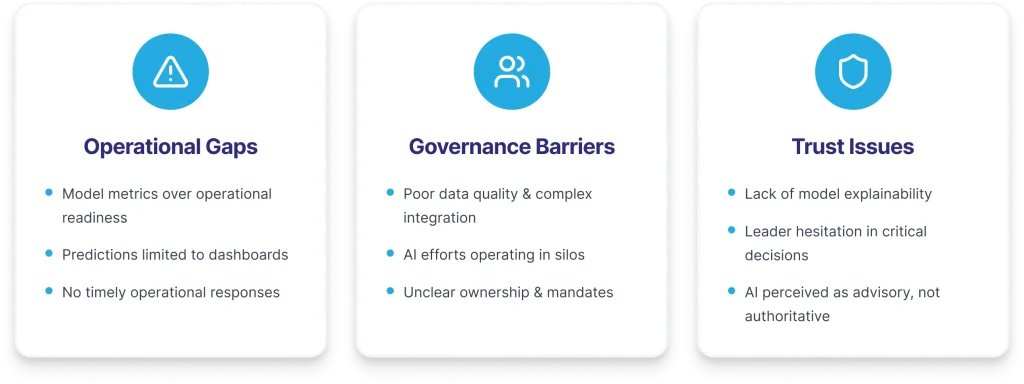
The Result: Without addressing these barriers, AI initiatives remain isolated experiments rather than becoming integrated operational capabilities.
Common failure points when scaling include:
- Exaggerate model performance metrics such as precision and recall, while neglecting operational readiness.
- Predictive models that are limited to dashboards rather than being built into daily processes.
- Predictions that fail to trigger timely operational responses.
Governance and organisational barriers further limit scale:
- Poor data quality and complex system integration stop AI projects from moving beyond the pilot stage
- AI efforts operating in silos, driven by technology teams without strong business alignment
- Absence of assigned ownership and clear mandates for operationalising AI outputs
Trust and adoption barriers also contribute:
- Lack of model explainability and traceability
- Leaders may hesitate to use AI in budgeting, supply chain, risk management, or customer strategies.
- Perception of AI as advisory rather than authoritative in decision-making processes
Operationalising AI-Based Analytics Across Functions
To move beyond isolated predictions, enterprises must treat AI and analytics solutions as enterprise capabilities rather than discrete projects. This begins with aligning AI initiatives to measurable business outcomes. Instead of asking, “Can we predict this?” the more strategic question is, “How will this prediction change operational behaviour?”
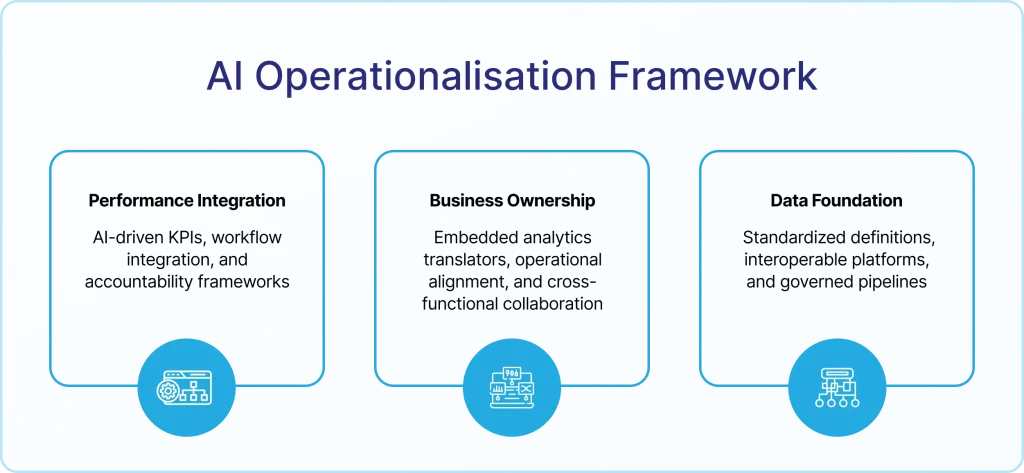
Operationalisation requires integration at three levels:
- Standardise data foundations: Ensure consistent definitions, governed data pipelines, and interoperable platforms to support scalable AI analytics.
- Embed ownership in business units: Move beyond centralised data science teams by placing analytics translators within finance, operations, marketing, and risk to drive real-world adoption.
- Align performance with AI insights: Embed AI-driven indicators into KPIs so insights directly influence accountability, operations, and decision-making.
Leading enterprises operationalise AI through orchestration systems that integrate predictive models directly into enterprise resource planning systems, customer relationship management tools, and workflow engines. In this setup, AI insights automatically trigger actions like price variations or maintenance alerts instead of just creating reports.
Embedding AI Data Insights into Workflows, Not Dashboards
Dashboards are used for tracking performance, but the value of AI analytics becomes apparent when insights are integrated directly into everyday operations. Predictive insights should link with the exact moment when a decision is made.
Integrating AI insights into workflows requires collaboration between data teams and business owners. It means identifying key decision points and embedding predictive results directly into systems and workflows. In many cases, this requires redesigning legacy processes instead of simply layering analytics on top of them.
- Create feedback loops: Each decision that is made by AI must produce new data that feeds back into the model to support constant improvement and adjustment to evolving business circumstances.
- Enable continuous learning: Ongoing refinement shifts predictive analytics from static forecasts into adaptive, transforming systems.
- Combine AI with automation: Integrate advanced analytics with robotic process automation and intelligent orchestration to reduce manual effort and delays.
- Human-supported: Use AI to provide timely, context-aware intelligence that supports better decisions while maintaining human oversight.
Ensuring Trust, Explainability, and Accountability
- Establish structured governance: Scaling AI-based analytics requires clear governance frameworks to ensure transparency and traceability, building trust and executive confidence.
- Prioritise explainability: Leaders and regulators must understand how predictive models generate outcomes. Model interpretability and feature analysis assist in justifying AI-driven decisions, especially in regulated industries.
- Define clear accountability: Ownership of model validation, deployment, and performance monitoring must be assigned when AI influences revenue, risk, or compliance decisions.
- Strengthen trust frameworks: Governance and trustworthiness are critical factors in successfully scaling enterprise AI initiatives.
- Ensure lifecycle risk oversight: Manage AI as a dynamic asset through version control, retraining, bias testing, and continuous performance monitoring.
In Conclusion: From Prediction to Operational Intelligence
Moving from experimentation to enterprise-wide impact is a critical turning point. AI-based analytics create real value only when they reshape how decisions are made across functions, shifting the focus from isolated models to integrated systems that connect data, workflows, and governance.
Enterprises that scale successfully invest in unified data architecture, align analytics with measurable business outcomes, integrate insights into daily processes, and strengthen governance to build trust. AI analytics prove their worth when insights are dependable and regularly influence business decisions.
Transform your data AI analytics from an isolated capability into a strategic infrastructure. Collaborate with SquareOne to move beyond predictive ambition and build AI as a reliable engine of operational insight.