
AI-Ready Enterprises Start with Content: How ECM Powers Smarter Business Decisions
It is common knowledge. That the vast majority of enterprise information remains inaccessible to standard analytics and artificial intelligence (AI) tools in the current landscape. Research shows that between 80 and 90% of enterprise data is unstructured, residing in formats such as contracts, emails, reports, and multimedia files that traditional systems cannot efficiently harness. This disconnect limits operational visibility and blocks the realisation of AI’s full potential across business functions.
For organisations seeking competitive advantage, the imperative to unlock this latent value has never been greater. Enterprise content management solutions are central to digital transformation, enabling firms to consolidate, govern, and leverage content across repositories.
A robust enterprise content management system does more than store information; it provides the foundation for AI-driven insights by ensuring content is structured, governed, and accessible. This blog explores how ECM supports smarter business strategies, works alongside AI, and turns content into a valuable business asset.
Managing the Challenges of Unstructured Content
Unstructured data represents content that lacks a predefined model or easily accessible structure. Spanning various formats, some of which include documents, presentations, images, audio, and video, it comprises the bulk of corporate knowledge and context. Yet, this data exists outside standard relational systems like ERP or CRM, and has historically proven difficult to manage and analyse at scale.
For AI deployment, this is a textbook case of a critical bottleneck. Enterprises may invest heavily in advanced modelling and machine learning, but without consolidated, governed content, these AI investments deliver limited value. In fact, research highlights that poor management of unstructured content constrains enterprise AI initiatives, often leading to incomplete insights or unreliable outputs.
Why AI-Ready ECM Solutions Matter
An AI-ready and current enterprise content management system is designed to overcome this issue. Unlike traditional file storage or simple document repositories, an ECM platform organises information across its entire lifecycle – from capture and classification to retention, retrieval, and eventual disposition. By centralising and structuring content, such ECM solutions ensure that all digital assets are discoverable, secure, and aligned with business processes.
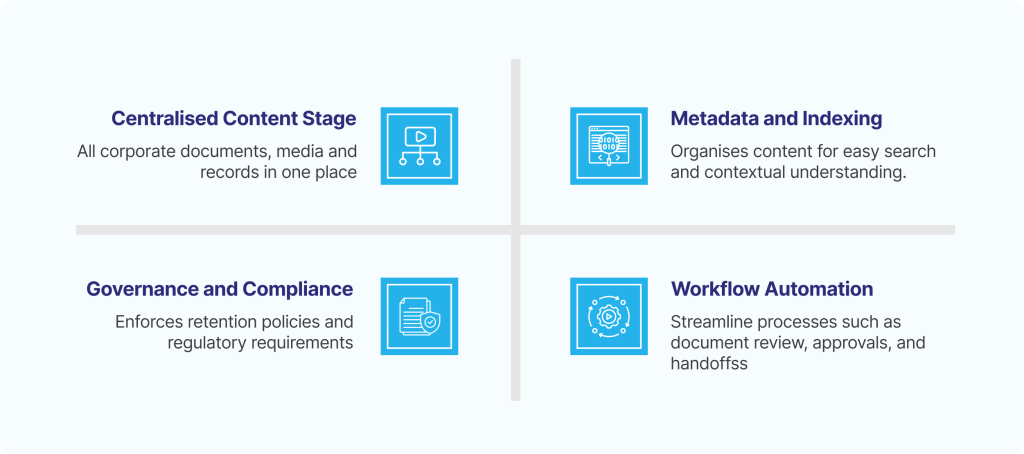
Key functions of modern ECM solutions include:
This framework transforms content from a passive corporate asset into an actionable business resource.From Document Management to Strategic Decision Support
It is no longer sufficient to merely manage files; organisations require an enterprise document management capability that feeds AI and analytics with high‑quality, trustworthy data. By integrating ECM with advanced technologies, businesses can propel content into enterprise intelligence platforms, enhancing decision support with contextualised insights.
For example, contracts stored within an enterprise content management system can be indexed and analysed to extract risk indicators, compliance obligations, and performance terms, all without manual review.
Moreover, ECM workflows route and prioritise key records, reducing delays and manual errors. These improvements not only improve internal efficiencies but also enhance downstream customer and stakeholder outcomes.
Bridging Content Silos
The challenge of multiple content repositories, such as shared drives, legacy document systems, and industry-specific storage platforms, has been a constant barrier for large firms. Isolated repositories impair search, discovery and governance and bring about risk in case information is duplicated or obsolete.
Enterprise content management companies have responded with federation capabilities that unify access without necessitating wholesale migration. By structuring content from multiple systems into a unified model, organisations gain a single view of their information while keeping sources intact. This federated model reduces the impact of disruption and accelerates AI preparedness through the formation of a unified search, governance and analytics layer.
AI in Content Management:Catalysing Foundational Transformation
With the foundation of structured and indexed content in place, businesses can begin to leverage AI in content management to drive substantial value. AI technologies applied to ECM data can execute tasks such as:
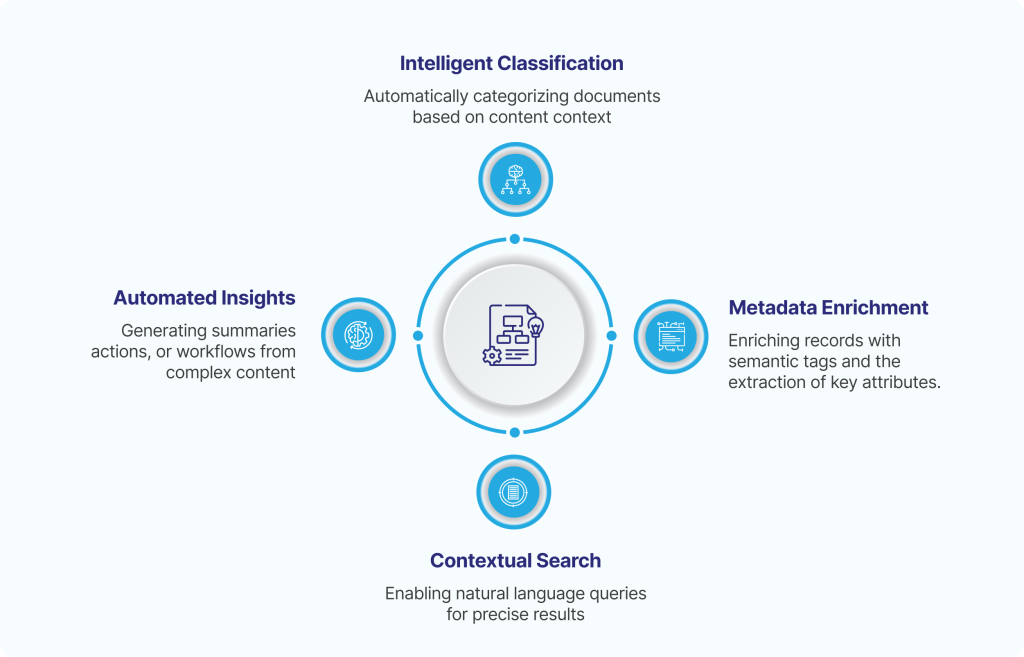
These capabilities turn an enterprise content management system into a platform capable of enabling better decisions across departments.
Delivering Measurable Business Impact
The value of integrating ECM solutions with AI is reflected in tangible business outcomes. Organisations with mature content practices often report
Improved operational efficiency: Faster retrieval and reduced manual effort lead to improved productivity.
Better compliance and risk mitigation: Automated retention and governance minimise exposure to regulatory penalties.
Accelerated innovation: Teams can focus on high‑value work rather than administrative content management.
Enhanced decision quality: Leaders benefit from clearer data context, strengthening decision-making confidence.
These benefits are especially visible in environments with fast-moving content and short decision timelines. As an example, legal teams that operate on enterprise content management solutions can find the contract obligations easily in a short period of time, whereas the HR departments benefit from the workflow simplification and confidential records secured.
A Way Forward
As enterprises adopt AI, prioritising access to high-quality content is crucial. Also, without structured governance, AI initiatives may underperform. SquareOne observes that ECM systems built on structured data, enriched metadata, and strong governance consistently transform content into a strategic asset, enabling more informed, AI-driven decisions. Building on this, firms should consider the following key principles when evaluating ECM solutions:
Metadata enrichment and semantic search: Ensures content is intelligently described and discoverable, enhancing AI in content management outcomes.
Federation across repositories: Unifies content without migration, leveraging existing investments while breaking down silos.
Integration with business applications: Aligns ECM with ERP, CRM, and workflows, enabling automation and seamless information flow.
Governance and compliance: Embedding retention, access control, and audit policies creates a reliable foundation for scaling AI initiatives.
Aligned with AI and digital strategies, ECM platforms supported by SquareOne transform content into a driver of operational efficiency and strategic, data-driven decisions.
In Conclusion
The path to AI-led, informed decision-making begins with mastering enterprise content. ECM solutions transform unstructured data into secure, accessible, and AI-ready information, enabling organisations to operate with greater agility, stronger governance, and clearer strategic insight.
Organisations that prioritise structured content, robust metadata, and integrated systems are better positioned to translate information into meaningful outcomes. With the right approach to enterprise content management, content shifts from a fragmented resource to a reliable foundation for smarter, data-driven decisions.