
A Strategic Roadmap to Cloud Migration with Qlik Cloud
Introduction
Why are organisations turning to cloud transformations? This may sound like an elementary question, but it is one of the most critical for an economy that has been, for long, making faulty decisions based on inaccurate data insights. The urgency to modernise their analytics infrastructure to gain accurate data-led insights, therefore, has never been greater. A structured Qlik Cloud migration is one of the most effective routes businesses can take to gain higher analytics capacity, become more scalable and agile, and make better-informed business decisions.
In our previous blog, we showed how Qlik Cloud delivers greater agility, scalability, and long-term value, highlighting that analytics is moving decisively to the cloud. This blog builds on that insight by outlining the fastest, most cost-effective way to move to Qlik Cloud.
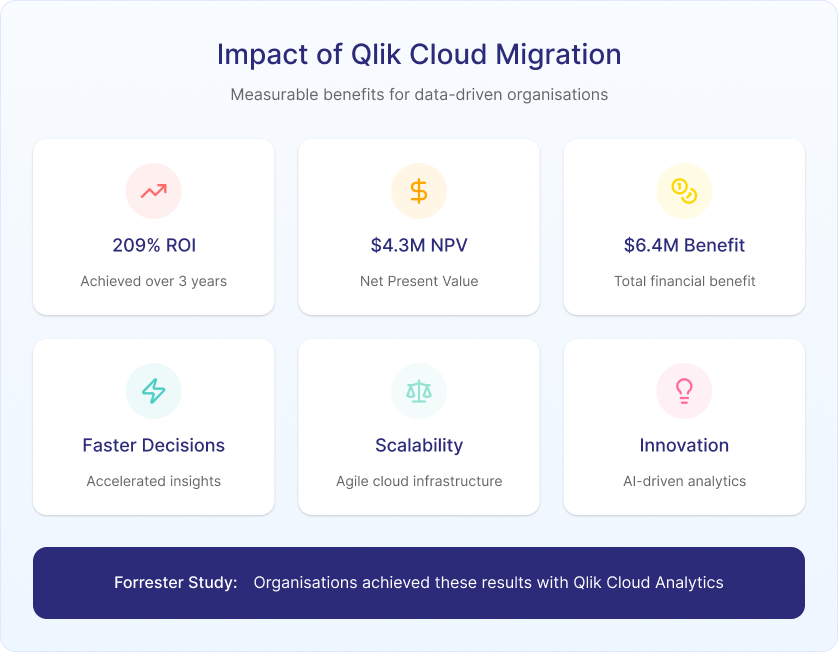
A Forrester Total Economic Impact study found that organisations using Qlik Cloud Analytics achieved a 209% ROI and a net present value of US$4.3 million over three years. To achieve these outcomes, enterprises need a well-defined Qlik Cloud implementation plan and a cloud deployment strategy that aligns technical transition with business ambition.
This structured approach to data analytics cloud migration ensures that modernisation efforts translate into measurable business value and long-term operational efficiency.
Key Stages of a Successful Qlik Cloud Migration
Establishing the Vision
Every successful migration begins with a clear purpose. Organisations must first determine how analytics supports their overarching strategy, whether to accelerate decision cycles, improve data accessibility, or enable advanced modelling capabilities. This clarity informs the Qlik Cloud deployment strategy, ensuring migration decisions directly contribute to measurable business results. Defining this vision early transforms the project from a technology upgrade into a value-creation initiative.
Assessing the Current Landscape
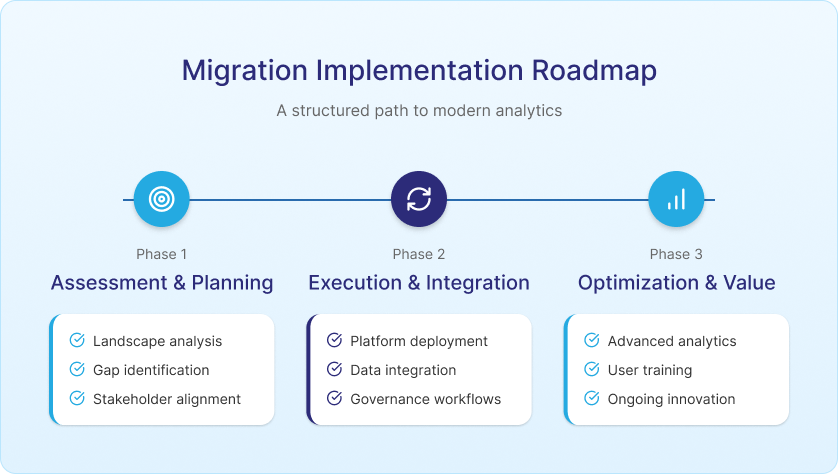
Migration cannot be initiated without a proper audit of the current analytics environment. This includes listing apps, dashboards, extensions, and data sources, usage frequency and ownership. The Qlik Analytics Migration Tool makes it easier by identifying which parts can be transferred to the Qlik Cloud without interference. In case certain data sources are left on-premises, the use of Qlik Data Gateway can guarantee low-latency and secure access both on-premises and post-migration. This assessment phase provides the foundation for informed planning and efficient execution.
Creating the Qlik Cloud Implementation Plan
Once the current landscape is mapped, the next step is to formalise a structured Qlik Cloud implementation plan. Begin with pilot migrations of low-risk applications, followed by progressive scaling to enterprise-critical workloads. Choose a capacity-based pricing model that supports future growth while maintaining cost efficiency. Governance is crucial—define roles, permissions, and access hierarchies to maintain security and data integrity. Establish validation checkpoints that assess data accuracy, application responsiveness, and user adoption at each phase.
Executing the Migration and Deployment Strategy
The successful migration will be a risk-phased roll-out. Qlik migration tools can automate the process of transferring apps, data and security configurations and minimise manual interventions. Begin with a small-scale migration; you can migrate a few applications and prove that the strategy works, then proceed to other departments.
Monitor performance metrics, verify data consistency, and refine scripts post-migration. Retiring outdated or redundant dashboards also simplifies maintenance and improves usability. The ultimate goal is not just transition but transformation—an environment optimised for data agility and collaboration.
Unlocking Advanced Analytics Value
Qlik Cloud is capable of achieving its full potential after migration. The platform also allows the replication of data without the use of code, AI-based insights, and live dashboards, which make the process of decision-making faster. The centralisation of analytics on a single platform provides teams with access to controlled sets of data, automation frameworks, and self-service analytics.
Managing Change and Measuring Impact
Migration success depends on sustained adoption and measurable improvement. Effective change management ensures that teams embrace the new cloud environment. Invest in structured training for data users and analysts, introducing them to Qlik Cloud’s intuitive interface and collaboration features.
Define clear key performance indicators—such as reduced maintenance cost, improved time-to-insight, or increased dashboard utilization: to quantify success. According to Forrester, enterprises leveraging Qlik Cloud realised a financial benefit of US $6.4 million over three years. Regular post-migration reviews help align evolving business needs with ongoing analytics improvements.
Building a Future-Ready Cloud Deployment Strategy
The final step is sustaining long-term value through a future-orientated cloud deployment strategy. This involves adopting scalable hosting regions that meet global data residency requirements, establishing continuous governance protocols, and integrating Qlik Cloud with other enterprise platforms.
Capacity-based pricing allows organisations to expand usage dynamically, while native governance capabilities maintain compliance and security. With continuous enhancements in automation, AI integration, and open APIs, Qlik Cloud positions enterprises to scale analytics initiatives with minimal friction.
In Conclusion
A well-executed Qlik Cloud migration is more than a technical transition—it is a strategic reinvention of how data delivers value. By aligning assessment, phased migration, and governance under a cohesive roadmap, organisations can achieve agility, cost efficiency, and sustained innovation. The journey from on-premises to Qlik Cloud ultimately empowers teams to move from data management to data mastery, unlocking richer insights and competitive advantage.