
10 High-Impact Workflow Automation Use Cases for Modern Enterprises
Introduction
Relentless pressure to deliver faster, smarter, and more accurate outcomes – a harsh reality that enterprises today live and grapple with every day. However, workflow automation is steadily becoming a critical driver of enterprise efficiency, transforming repetitive tasks into smooth, error-free processes while empowering teams to focus on strategic priorities.
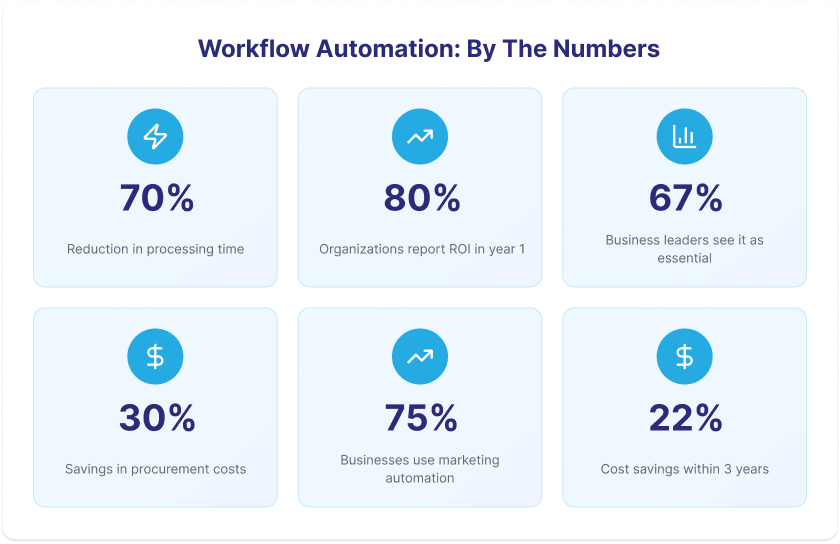
Research indicates that automated processes can reduce processing time by up to 70%, with 80% of organisations having reported huge returns within the first year. Ten workflow automation use cases have emerged as especially impactful as business process automation and digital process automation expand across key enterprise functions. Through this blog, we will explore how these applications enhance efficiency, precision, and productivity.
Essential Workflow Automation Use Cases for Today’s Enterprises
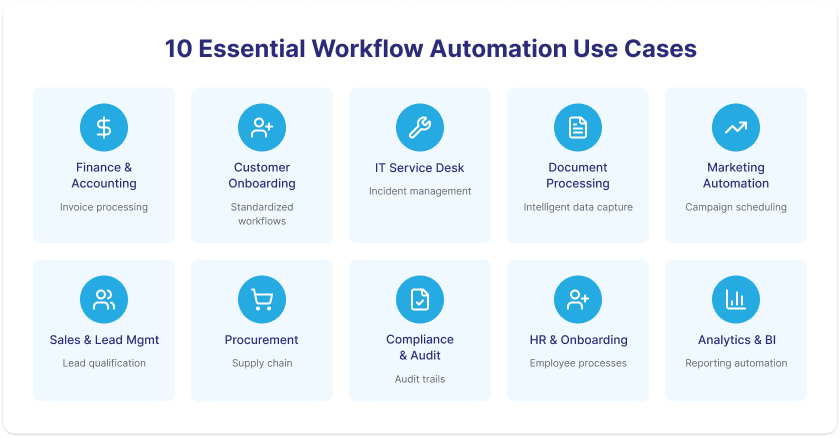
Finance and Accounting Automation
Business process automation examples hold immense value for finance departments. Automating invoice processing, accounts payable, and expense management minimises manual mistakes and conserves more than 500 hours of finance department work per year. In fact, a 2025 SAPInsider report finds that 52% of firms use automation to streamline processes and shorten cycle times.
Customer Onboarding Workflows
Automated workflows for customer onboarding cut down delays, standardise interactions, and ensure compliant documentation. In these examples of automation in digital processes, automation can also reduce their customer onboarding time by a large margin, according to reports, up to 60% in some industries.
Incident Management and IT Service Desk
In IT operations, a workflow automation example often includes automated incident logging, intelligent routing, and contextual triggers. Studies indicate that such process automation examples can reduce resolution time by 50 to 70% while improving service desk efficiency and employee satisfaction.
Document Processing and Intelligent Data Capture
Enterprises often deal with a massive volume of unstructured documents: invoices, contracts, and receipts. Intelligent document processing (IDP) combined with workflow automation agents can recognise, extract, and classify data, triggering downstream workflows. A recent academic study demonstrated an over 80% reduction in processing time for expense receipts, with fewer errors and enhanced compliance.
Marketing Automation Workflows
Marketing teams are among the most enthusiastic adopters of workflow automation. Automated workflow examples in marketing, such as email campaign scheduling, lead nurturing, and social media posting, reduce manual effort by 70%, according to finance leaders surveyed in a recent report. In fact, 75% of businesses now use at least one form of marketing automation, primarily to boost lead generation.
Sales and Lead Management
Business automation examples in sales include automated lead qualification, routing, and timely follow-ups. Automation can speed up the quote-to-cash process and eliminate delays by ensuring fewer manual handoffs and enhancing revenue conversion. Process automation also helps in imposing sales discipline, as well as standardising customer experience.
Procurement and Supply Chain
Automation plays a transformative role in procure-to-pay cycles. Enterprises using workflow automation in procurement report up to 30% savings in procurement costs and more accurate supplier interactions. Through automated approvals, vendor onboarding, and purchase order reconciliation, organisations avoid manual bottlenecks and improve operational transparency.
Compliance and Audit Trail Management
Process automation using examples in highly regulated industries, such as keeping audit trails, compliance checks, and the regular generation of reports. Automated working processes are able to minimise the risk of non-compliance with the business since they can ensure that every process is well documented, the necessary approvals are implemented, and regulatory reporting is simplified. This helps raise governance as well as reduce risk exposure.
HR and Employee Onboarding
Automated workflow examples are employee onboarding, leaves, and performance review scheduling. HR departments automate the process of document collection, approvals, and training to decrease administration and enhance the experience of new employees. Numerous organisations use the additional time that automation has freed for innovation, training, and employee engagement, according to SAPInsider.
Analytics, Reporting and Business Intelligence
Digital process automation also supports analytics-driven decision-making. Automated workflows collate data from different systems, validate it, and feed business intelligence platforms in real time. This allows leaders to identify bottlenecks, monitor KPIs, and continuously refine operations. According to industry research, 67% of business leaders consider workflow automation essential for strategic transformation.
Why These Use Cases Matter
These 10 applications demonstrate how companies use business automation and automated workflow models in finance, operations, marketing, and HR. Workflow automation helps increase the quality of the work and minimise the error rate and enables employees to concentrate on high-value work and strategy.
In Conclusion
Workflow automation is far more than a backend tool; it is a strategic lever that empowers modern enterprises to scale, innovate, and maintain a competitive advantage. By integrating business process automation across finance, marketing, HR, supply chain, and more, organisations can unlock higher productivity, stronger compliance, and measurable ROI. As adoption accelerates, the most forward‑thinking leaders will be those who combine automation with real‑time intelligence, turning automated workflows into engines of growth.