
5 Reasons Why Qlik Cloud Delivers More Value as an Analytics Model Versus On-Prem
Introduction
Gartner research forecasts that global end-user spending on public cloud services will reach a whopping S$723.4 billion by the end of 2025. Against this backdrop, analytics platforms like Qlik face a pivotal shift in the cloud vs on-prem debate, as more organisations evaluate how moving to the cloud strengthens scalability, agility, and long-term value.
Analytics today is about driving insight, agility, and workflow value. This blog compares Qlik Cloud and on-prem models to determine the differences between on-premise and cloud, which translate into better enterprise value delivery.
On-Premises Analytics: Strengths and Limitations
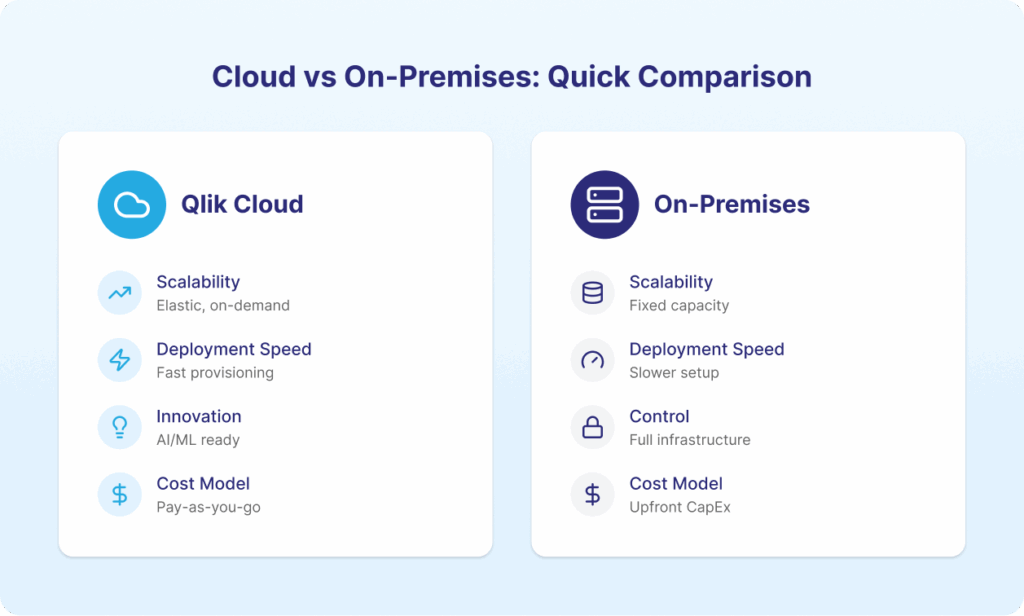
Deploying analytics on-premises has long been the standard for many enterprises. One key advantage is the full control it offers over infrastructure, data residency, and deployment customisation. This model works well for organisations with stable, predictable workloads, strict compliance requirements, or significant existing investments in their own infrastructure.
However, major limitations exist. As noted by McKinsey & Company, only about 10 % of cloud transformations achieve full value, owing in part to infrastructure and operational complexity. In the on-prem analytics model, it leads to high maintenance and hardware costs, reduced scalability, slower insights, and greater IT loads, which regularly reduce innovation due to increasing data volumes and applications. Understanding why on-premise is better than cloud in some specific, regulated environments is crucial for businesses evaluating long-term strategies.
Qlik Cloud: Value Drivers
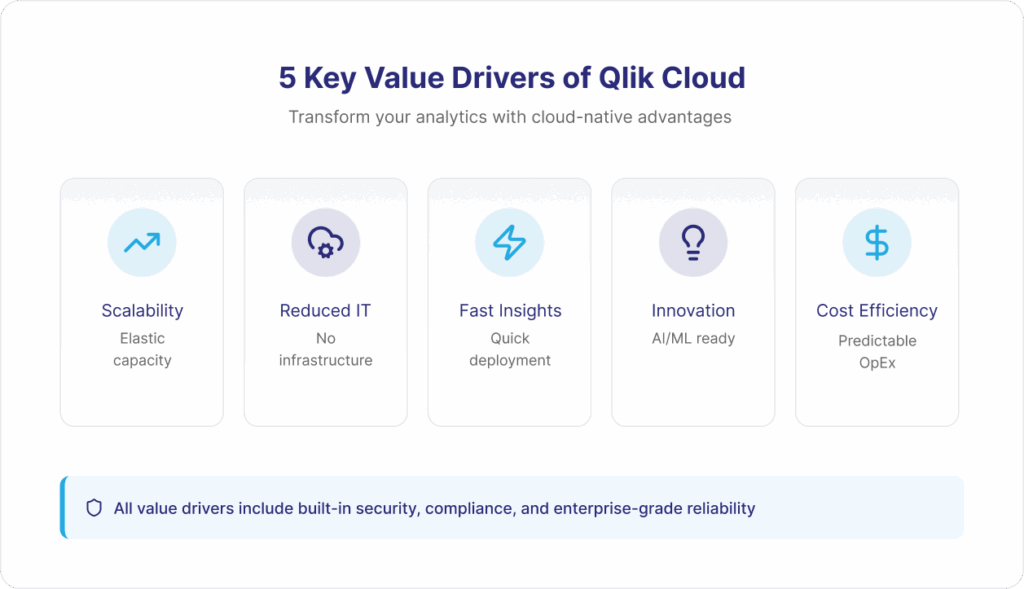
The cloud-based model of Qlik Cloud brings several value drivers. From Qlik’s own comparison guide: cloud deployment enhances data management, offers built-in security and compliance, supports AI-powered analytics, and simplifies operational overhead relative to on-premises installations. This model highlights the evolving difference between on-premise and cloud and why many enterprises are now prioritising flexible, cloud-native deployments.
Key value levers are:
Scalability and Elasticity
The platform scales as per business demand, preventing oversized capacity investments and enabling quick workload expansion, making it one of the key advantages of cloud infrastructure vs on-premise models.
Reduced Infrastructure
IT teams no longer need to manage hardware, patching, backups, or the physical components of data centres. This frees up resources for strategic analytics rather than infrastructure upkeep, underscoring the operational distinction between a cloud server and an on-premise environment.
Faster Time-to-Insight
With cloud deployment, analytics applications can be provisioned more quickly, enabling business users to access insights sooner and respond to changing circumstances. This agility defines the modern cloud solution vs on-premise performance advantage.
Advanced Analytics and Innovation
Qlik Cloud incorporates features such as automation, machine learning integration and rich data source connectivity. Migrating to cloud positions organisations to exploit these capabilities, which are harder to deliver in legacy on-premises environments.
Cost Efficiency and Predictability
While the cloud is not necessarily inexpensive in every scenario, the shift from upfront capital expenditure to a capacity and subscription model can improve financial predictability. For example, Qlik allows capacity-based licensing where cost is tied to the data analysed, not the number of users.
Comparative Value: Which Model Delivers Better?
To decide which model delivers better value, organisations should evaluate several dimensions of cloud computing vs on-premise.
Total Cost of Ownership (TCO)
On-premises can be economical to use on the stable, high-use workloads, but cloud provides higher value as the workload becomes more variable. McKinsey’s research suggests that capturing the full value of the cloud requires more than just migration; it demands new processes, governance and operational change.
Agility and Innovation
Cloud platforms clearly lead in agility: their ability to scale, support new use cases and integrate new technologies provides a competitive edge. If the business intends to expand analytics into AI, machine learning or real-time use cases, the cloud offers higher value.
Governance, Compliance and Data Residency
On-premises deployments may retain an advantage in environments with stringent regulatory/data sovereignty requirements. Cloud providers are improving in this regard, yet organisations must assess their jurisdictional, security and data-governance needs to decide between cloud vs on-prem deployment.
Performance and Predictability
If the analytics workload is predictable, stable and bound(ed), on-premise may deliver predictable performance at perhaps a lower incremental cost. In contrast, cloud introduces variable cost models and perhaps multi-tenant performance characteristics that need careful governance, further reflecting the difference between on-premise and cloud for workload management.
Long-Term Strategies
Given the forecast that most workloads will shift to cloud or hybrid models, Gartner predicts 90% of organisations will adopt hybrid cloud by 2027; staying on-premises indefinitely may entail the risk of obsolescence, higher maintenance, and missed innovation, a clear insight for companies evaluating cloud infrastructure vs on-premise strategies.
Recommendation for Qlik Analytics Deployment
If your organisation aims to scale analytics, enable AI/ML, support remote users, and reduce IT overhead, Qlik Cloud offers greater value. On-premise remains viable for stable, fully utilised infrastructures but should include a transition plan. Strategically, the cloud delivers superior flexibility, innovation, and speed, while on-prem suits cases prioritise data sovereignty and predictable workloads.
In Conclusion
Choosing between Qlik Cloud and on-premises analytics depends on organisational priorities. While on-premises suites controlled compliance-heavy environments, Qlik Cloud offers greater agility, scalability and long-term value. The future of analytics is decisively cloud-driven, and those who adapt early will unlock deeper, faster insights.