
Why Do 8 out of 10 Agentic AI Projects Fail? Key Challenges and How to Overcome Them
According to IDC research, nearly 88% of agentic AI projects fail to deliver expected productivity. Given that agentic AI, an enhanced version of Generative AI, can manage its own processes and operate across multiple platforms without human intervention, this failure is indeed a concern.
The autonomous nature of agentic AI or AI agents, which makes them stand out, also adds to their complexity, making them difficult to deploy successfully in enterprises. However, with a systematic and disciplined approach, translating AI agents’ potential into substantial results is possible. In this blog, we will discuss the agentic AI challenges and ways to overcome them.
Why Agentic AI Projects Fail: 5 Key Challenges that Enterprises Face
As businesses start to adopt AI agents, it has become apparent that, in most cases, they fail to perform. And the failure is not the same as a regular software glitch but rather a crucial issue that requires specific attention. It does not emerge from a predictable factor like a weak model or an unsuitable framework. Poor deployment, undefined workflow, and unprepared users are key factors in this context. To shed more light on this, let’s discuss the challenges in implementing agentic AI systems.
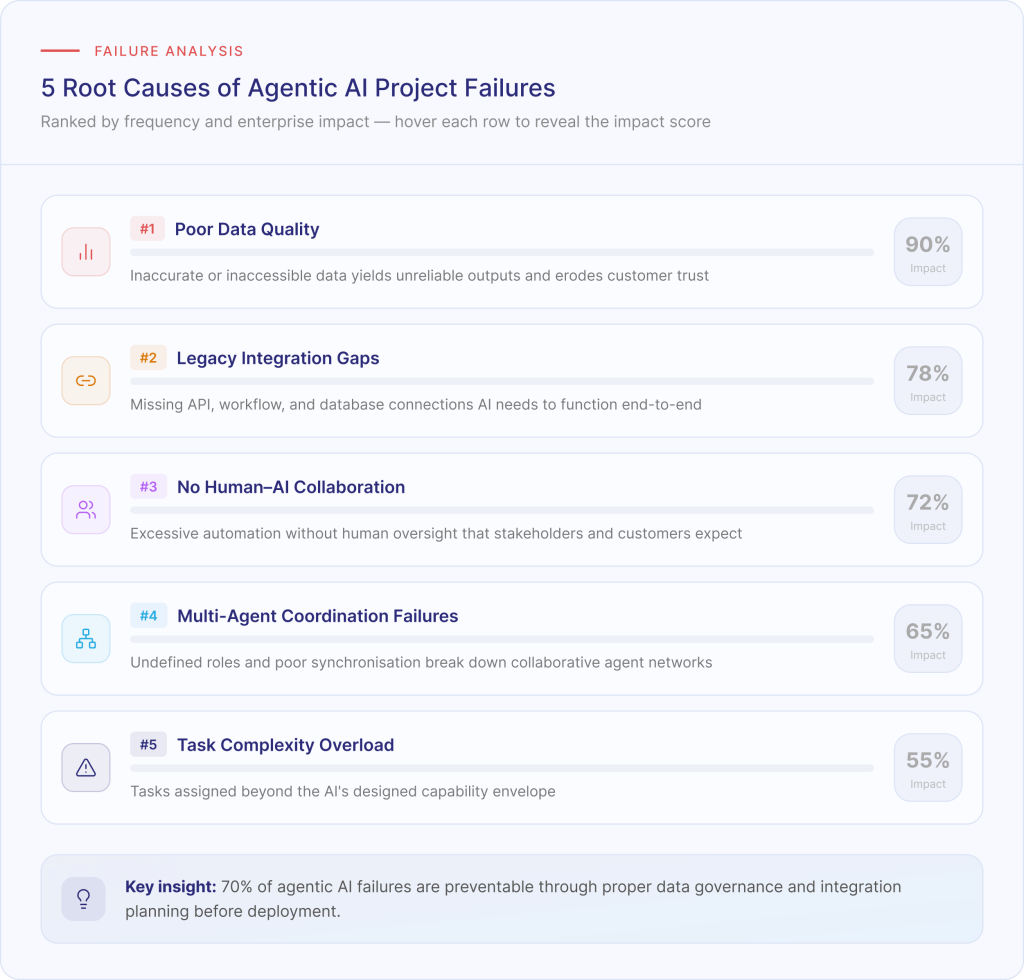
Poor Data Issues
AI agents often fail due to poor, unclear, and inaccessible data, which tends to yield inaccurate and unreliable outputs. It leads to the loss of customer trust and enterprise reputation in AI-powered customer support systems, AI portals, and other agentic AI domains.
Lack of Systematic Integration to Legacy Systems
Though agentic AI is one of the smartest inventions, it cannot work without being integrated with the APIs, workflows, and databases required to complete the tasks. Many times, agentic AI projects fail because AI initiatives focus heavily on natural language understanding and chat interfaces, ignoring secure, effective system integration.
No Initiative of Human and AI Collaboration
Another reason why AI initiatives fail in enterprises is the excessive reliance on full-on AI automation. Augmenting human intervention with AI agents leads to better outcomes, whether in enterprise workforce management, customer support, or other areas. With only an AI-driven approach, the human touch is missing in many cases that business stakeholders and customers seek.
Lack of Supervision to Handle Multi-agent Complexities
In most enterprise environments, a collaborative AI network is used. When one agent segregates data, another analyses it, and another one makes decisions. Due to undefined roles, poor synchronisation and lack of shared context, the collaboration breaks down.
The Complexity of Tasks
Although agentic AI is designed to handle diverse enterprise tasks, sometimes the tasks assigned to it are more complex than its capabilities can handle. This is one of the reasons why agentic AI projects fail, and enterprise-level outcomes cannot be delivered by the AI agents.
How to Overcome the Reasons for Agentic AI Failures
Understanding the crucial challenges that new-age enterprises face when deploying agentic AI has led to strategies that have been demonstrated to overcome these AI project failure reasons.
Invest in Data Management Beforehand
It is important to focus on data governance and data readiness efficiently before the data are used in the agentic AI framework. It helps to get the clean, contextual, and integrated data.
Ensure Building a Suitable Infrastructure
Before scaling your AI pilots or implementing agentic AI systems, build the right environment for them. Make sure that all API and workflow integrations are incorporated there.
SquareOne offers secure, robust agentic AI technology designed to work seamlessly with your enterprise architecture.
Define AI Capabilities
Understand the strengths and limitations of the AI agents before assigning them tasks. Initially, begin with well-defined tasks that the agents can easily handle, and thereafter proceed to more complex tasks under the supervision of technology experts.
Conclusion
The inability to deliver the desired enterprise value will mean nearly 40% of agentic AI projects getting cancelled by 2027, according to a Gartner report. To avoid such pitfalls of autonomous AI systems, enterprises must tailor their agentic AI initiatives to address customer pain points and meet business gaps before the deployment of the agents. Measure the capabilities of the agents and the current infrastructure and embed thorough oversight and governance of the AI network.
SquareOne, as a leading technology partner for enterprises in the GCC, provides advanced agentic AI solutions that overcome the common agentic AI challenges and help to enhance your business performance. Build a powerful agentic AI architecture tailored to your enterprise values with us.
Learn more about our agentic AI solutions from our experts!