
Process Mining vs Task Mining: Key Differences and When to Use Each in Enterprise Automation
According to Gartner, by 2026, 30% of enterprises will automate more than half of their network activities. This growing reliance on automation makes it an indispensable part of the modern enterprise framework. Business process automation redefines the company’s workflow, enhancing its agility and efficiency.
Process mining and task mining are two potent tools that offer alternative knowledge about operations. They both are geared towards better automation of enterprise processes, but differ in scope, data sources, and outcomes. In this blog, we briefly cover process mining and task mining, the key differences between the mining processes, and when they are used in enterprise automation.
An Overview of Process Mining
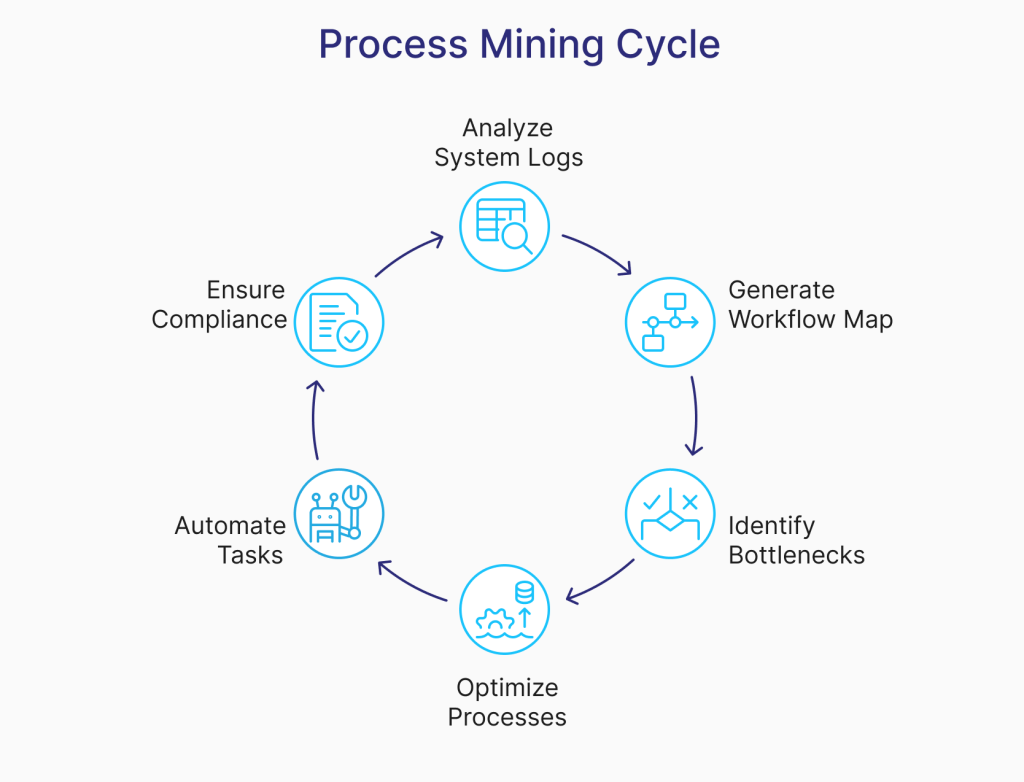
Business processes evolve, bringing more complex and difficult scenarios. Process mining is a way to address this issue by analysing system logs to generate a visual end-to-end workflow map across systems. It compares how the processes work and how they should actually operate. In a recent report, using process mining, 46% of organisations reduced throughput time, and 41% lowered manual effort.
Revealing bottlenecks, inefficiencies, automation opportunities at the process level, as well as compliance gaps, becomes easier with process mining. It is typically used in identifying delays in order processing, optimising processes within the supply chain, and controlling compliance. With SquareOne’s process mining tools, enterprises can view and manage their operations, enabling more strategic planning and execution.
A Brief Introduction to Task Mining
Task mining records user-level activity across applications and desktops. It analyses the individual tasks of a process at a granular level using data sources such as user desktop interactions, UI logs, and screen recordings. It focuses on learning the exact steps users take at the workstation and can be used to detect repetitive, time-consuming, or error-prone tasks that are strong candidates for automation.
The result is increased user productivity and the ability to implement quick-win automations. As a parallel approach to process mining, task mining provides micro-level details, offers a view of processes and individual tasks, and can be applied to smarter automation of enterprise workflows.
Task Mining vs Process Mining: What Sets Them Apart
The main distinction between process and task mining is based on their focus and data. Process mining analyses macro-level workflows using system logs, while task mining maps micro-level user interactions to optimise tasks. The reason for using process mining is to identify inefficiencies across departments, and task mining is used to provide information on each employee’s activity and process bottlenecks.
When combined, process and task mining provide a comprehensive view of enterprise automation.
- Together, they reveal both the flow of processes across systems and the way employees perform tasks.
- Enterprise automation tools then highlight opportunities to introduce quick-win automations.
- They also help enhance productivity and standardise best practices by evaluating user interactions at the workstation level.
- This approach is especially valuable in areas such as enterprise marketing automation and customer service, where speed and accuracy are critical.
Often, the most effective tactic is to unite both, i.e., process mining to see the workflow at a macro level and task mining to get data at a micro level. Thus, the comprehensive roadmap of workflow automation is built, ensuring a better ROI. This ultimately makes automation initiatives efficient, scalable, and sustainable in the long term.
Key Takeaways
The benefits of using the two most important enterprise process automation tools, which are process and task mining, are endless. Knowing the difference between the tools will make organisations leverage them better. Process mining is concerned with workflow optimisation, unlike task mining, which is concerned with the optimisation of individual tasks. When these solutions are integrated, enterprises can come up with smarter and data-driven solutions to automate business operations and maximise productivity and operational efficiency.
As a leading digital innovation partner, SquareOne offers high-end enterprise automation tools that can streamline your business operations flawlessly. Ensure maximum efficiency in your company workflow with SquareOne’s advanced enterprise automation tools.