Governing Analytics at Scale: Moving from Control-Based Data Governance to Predictive Governance Models
By as early as next year, approximately 80% of data and analytics governance initiatives will prove futile if they are not flexible enough to align with business outcomes. The one-size-fits-all governance model will no longer be relevant. Instead, organisations need to opt for an agile and scalable strategy that works well across their overall ecosystem. Considering the importance of managed data in today’s world across enterprises, taking a dynamic approach to analytics data governance is indeed crucial. This blog, here, will therefore discuss how to govern data and analytics dynamically, ensuring maximum organisational benefits.
The Business Impact of Poor Data and Analytics Governance
Every organisation, regardless of its industry or size, handles a significant amount of data coming in from various sources. To evaluate, organise, and control the vast pool of data, a strategic governance system is required. However, when many organisations, without understanding its necessity, ignore data governance, their workflow sees a severe setback. Here are the impacts they face in such a scenario:
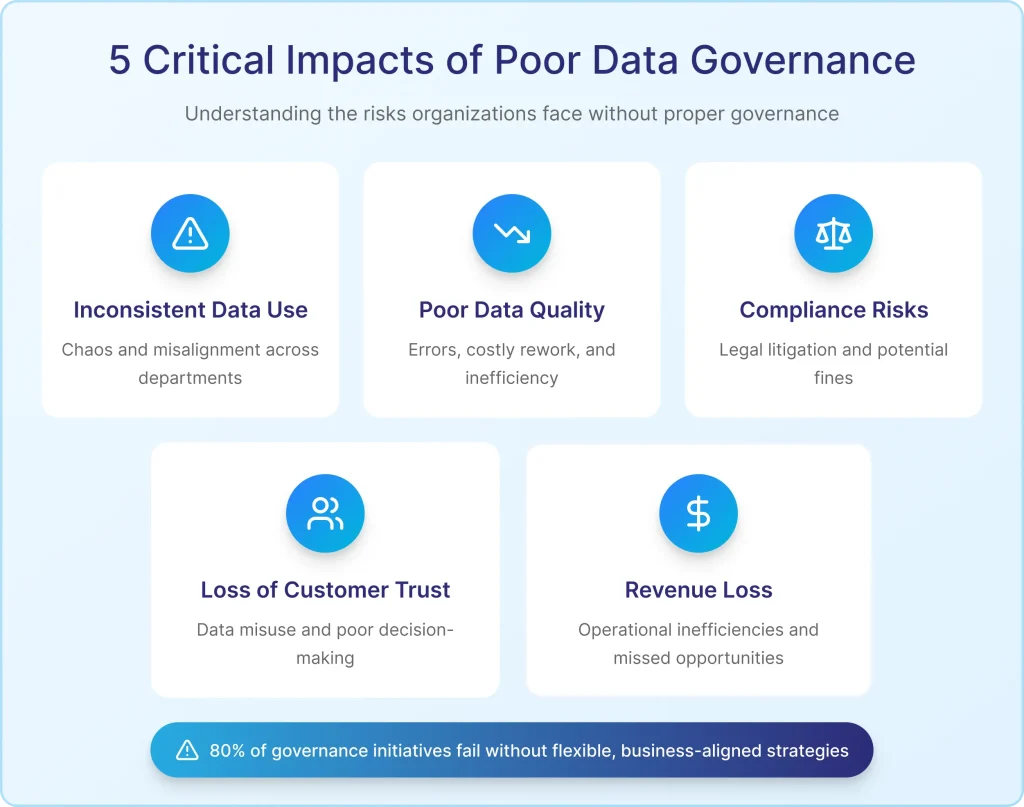
Inconsistent use of data
Diverse departments within a business organisation are likely to use data in various ways, as they see fit. If it is not managed with a flexible and modern approach, chaos, incorporating misalignment and confusion, takes place.
Poor Data Quality & Increased Cost
When data and analytics are not governed by expert supervision, errors and costly rework become common. Also, the inefficiency at work is more pronounced than ever, with data that can be lost, compromised, or manipulated.
Compliance risks
Without professionally managed data governance services, organisations often fail to comply with the latest industry standards and updated regulations. As a consequence of such non-compliance, the hassle of legal litigation and potential fines arises.
Lack of Customer Trust
Proficient data and analytics governance provides you with a clear, complete view of all your data assets, enabling you to make informed decisions and support your customers. Without governance, customers’ trust and confidence in you are likely to be hampered as the risks of data misuse, poor decision-making, etc., increase.
Revenue loss
Ungoverned data and analytics bring in operational inefficiencies, loss of customer loyalty, and missed sales opportunities. All of them together, along with a negative brand reputation, lead to a significant loss of revenue in any business.
In other words, a business’s growth and scalability are compromised when the decision makers ignore the necessity of managed data governance services provided by strong and agile platforms like Qlik.
How to Govern Analytics Dynamically: Steps to Follow
With the right predictive governance strategy for your organisational data and analytics, you can achieve both quick wins and long-term business success.
Your Roadmap to Dynamic Data Governance
Four essential steps to implement predictive governance at scale
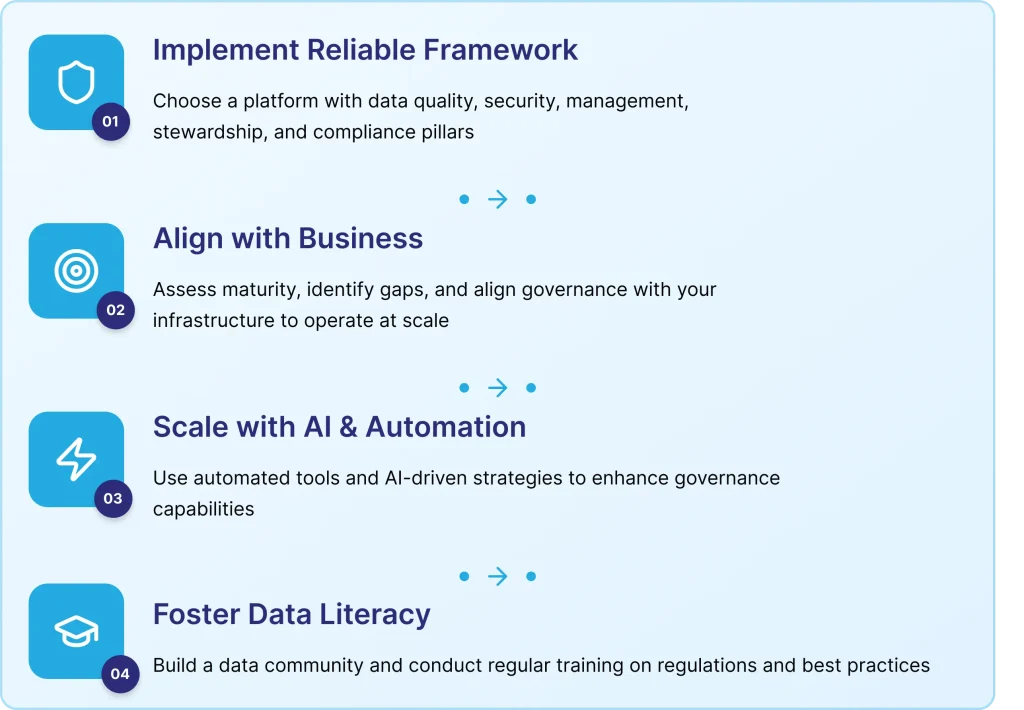
Implement a Reliable and Advanced Governance Framework
Choose a data and analytics governance platform that goes beyond conventional command-and-control methods. It must stand with the core pillars of analytics data governance, i.e., data quality, data security, data management, data stewardship, and data compliance. Make sure to create a suitable team to perform the roles associated with all pillars.
Align the Data Governance Programme with your Business
Understand your business goals and assess your company’s data governance maturity to identify the areas that require high priority. Find out the current governance challenges and gaps. Thereafter, align the data governance system with your business infrastructure to enable it to operate at scale and with speed.
Scale up the Strategy Using AI and Automation
Use automated data tools and AI-driven strategies to enhance the capabilities of your data and analytics governance framework. However, if you rely upon smart and scalable managed data governance services, you’ll indeed receive the support of the advanced tools and techniques as per the governance requirements.
Foster and Support Data Literacy
Create a standard data community that includes data producers and users, both of whom can help you develop practical, feasible data management policies. Alongside that, conduct regular training sessions on data literacy and awareness about data regulations for your organisation’s employees.
Adopting a predictive governance model that manages and safeguards your data and analytics is not a one-time solution. You need to constantly monitor, evaluate, and enhance your governance strategy to gain a competitive edge.
In Conclusion
Data and analytics governance is an ongoing process rather than a fixed strategy. Moreover, today’s AI-driven advanced analytics environment focuses on innovation and agility more than ever. So, taking a dynamic approach to data governance is the best way to utilise data’s full potential to scale your organisation.
SquareOne is a leading company that empowers enterprises with the best analytics data governance solutions that ensure speed, accuracy and compliance simultaneously. Make informed, data-driven decisions by uncovering relevant market trends with confidence.