
Building an Enterprise AI Search Solution with Discovery and Governance
Enterprise AI is no longer a future initiative. Organisations are embedding AI assistants, copilots, and Large Language Models into everyday operations to accelerate decisions, improve productivity, and unlock greater value from business information. Yet despite rapid adoption, many AI initiatives struggle to move beyond isolated use cases and deliver enterprise-wide impact.
The challenge is rarely the AI model itself. It is the information the model relies on.
Enterprise knowledge is scattered across Enterprise Content Management (ECM) platforms, ERP systems, SharePoint, Microsoft Exchange, cloud storage, emails, and countless business applications. Each repository contains valuable information, but none provides a complete view of the organisation. Without access to connected, governed, and contextually relevant knowledge, AI can only produce fragmented outcomes.
Building an AI-ready enterprise therefore starts with the information architecture behind AI. A federated search framework creates that foundation by connecting enterprise knowledge, preserving governance, and enabling secure discovery across every business system.
Rethinking Enterprise Search for the AI Era
Traditional enterprise search was built to help employees find documents using keywords. Today’s enterprises require much more than document retrieval.
Business knowledge is distributed across specialised systems, each serving a different purpose. Contracts reside in Enterprise Content Management platforms, customer communications in Microsoft Exchange, financial records in ERP systems, and project documentation across collaboration platforms. While every application stores valuable information, none provides a complete picture of the business.
This fragmented landscape affects more than employee productivity. Compliance teams struggle to retrieve complete information during audits, business users waste time navigating multiple repositories, and AI inherits the same disconnected view of enterprise knowledge. For AI to generate reliable insights, it must access trusted knowledge, not isolated repositories.
Building a Federated Search Framework
A common assumption is that improving enterprise search requires migrating all enterprise content into a single repository. In reality, large-scale migrations are expensive, disruptive, and often unnecessary.
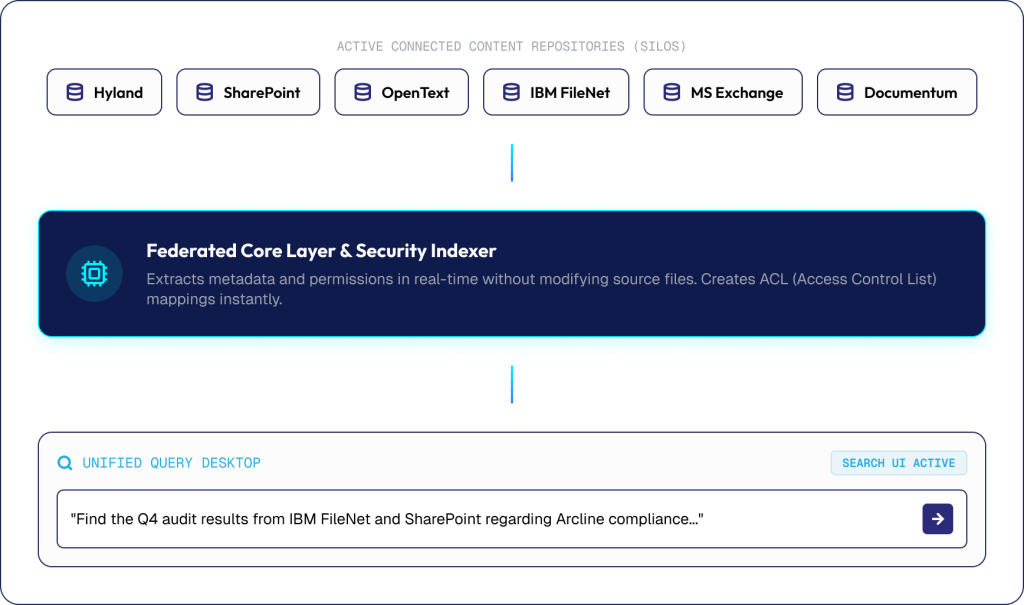
A true federated search approach takes a different path. Instead of moving enterprise content, a Federated Search Framework securely connects repositories such as Hyland, SharePoint, OpenText, IBM FileNet, Microsoft Exchange, Documentum, and other enterprise applications. Documents remain in their original systems while connectors continuously index content, metadata, and existing security permissions to create a unified knowledge layer.
Employees can search across every connected repository through a single natural language query without needing to know where information resides. Existing permissions remain intact, ensuring users only access information they are authorised to view.
Rather than replacing existing technology, organisations maximise the value of their Enterprise Content Management investments while creating a scalable foundation for enterprise AI.
Through its partnership with Texter Blue, SquareOne helps organisations implement this architecture without disrupting existing business systems.
From Keyword Search to Contextual Intelligence
Connecting enterprise repositories is only the first step. AI must also understand the information it retrieves.
Traditional search relies on keyword matching. Enterprise AI depends on meaning, relationships, and context.
Semantic search enables this shift by converting enterprise content into mathematical representations known as embeddings during indexing. Instead of searching for exact words, AI interprets user intent and retrieves information based on meaning.
For example, an employee searching for customer agreements with major manufacturing clients can retrieve the correct contracts even if those exact words never appear within the documents. The system understands context rather than matching keywords.
Unlike conventional AI search, where embeddings are generated after a query is submitted, semantic indexing prepares enterprise knowledge during content ingestion. This reduces response times, lowers AI processing costs, and provides more accurate information for Retrieval-Augmented Generation (RAG) and other enterprise AI applications.
Preparing Enterprise Knowledge Before AI Application
Many organisations expect a Large Language Model (LLM) to perform every stage of information processing. In reality, asking an LLM to extract text, classify information, understand context, and generate responses increases cost, latency, and complexity.
An effective AI architecture prepares enterprise knowledge before it reaches the model.
During content ingestion, scanned documents are converted into searchable text through Optical Character Recognition (OCR). Metadata is extracted, semantic embeddings are generated, and sensitive information is automatically identified and classified. By the time an LLM processes a request, it works with structured, context-rich information instead of thousands of unprocessed documents.
This allows AI to focus on reasoning and decision support rather than document preparation, resulting in faster responses, lower token consumption, and a scalable foundation for enterprise AI.
SquareOne and Texter Blue enable organisations to implement this knowledge-first approach, ensuring enterprise information is AI-ready before any model is introduced.
Embedding Governance into Enterprise AI
AI is only as trustworthy as the information it can securely access. As organisations expand AI across business functions, governance can no longer be treated as a compliance activity performed after information is retrieved. It must be embedded into the knowledge layer itself.
Many organisations only discover where sensitive information resides when responding to an audit, legal request, or regulatory investigation. By then, identifying personal data, financial records, contracts, or confidential business information across multiple repositories becomes both time-consuming and high-risk.
A True Federated Search architecture addresses this challenge during content ingestion. As enterprise content is indexed, sensitive information can be automatically identified, classified, and enriched with metadata. Instead of asking an AI model to recognise regulated information after retrieval, organisations know where critical data exists before AI interactions begin.
This governance-first approach strengthens regulatory compliance, simplifies audit readiness, and provides greater visibility across the enterprise information landscape. More importantly, it ensures AI operates on trusted and governed knowledge rather than unmanaged content spread across disconnected systems.
Preserving Security Without Compromising Accessibility
Connecting repositories should never weaken the security policies already protecting them.
A Federated Search Framework preserves the permissions and access controls defined within each connected system. Employees only discover information they are authorised to access, regardless of where that content resides. Existing security models remain unchanged, eliminating the need to recreate complex permission structures across multiple platforms.
The same principle extends to enterprise AI. Rather than exposing entire repositories to a Large Language Model, only authorised, contextually relevant information is retrieved. Every interaction can also be logged and audited, giving organisations complete visibility into how enterprise knowledge is accessed and used.
For highly regulated industries such as financial services, healthcare, government, and energy, this approach enables AI adoption without compromising governance, security, or regulatory compliance.
Future-Proofing Enterprise AI
Enterprise AI will continue to evolve. New models, deployment options, and regulatory requirements will emerge, but enterprise knowledge should not have to be rebuilt every time technology changes.
A future-ready architecture separates knowledge management from AI generation.
With a federated knowledge layer at its core, organisations can adopt public, private, or sovereign AI models while preserving the same trusted enterprise knowledge foundation. This model-agnostic approach protects existing technology investments, reduces vendor lock-in, and gives organisations the flexibility to adopt future AI innovations without restructuring their information architecture.
Through its partnership with Texter Blue, SquareOne helps organisations build Enterprise AI Search Solutions that are secure, scalable, and designed to evolve alongside the business.
Conclusion
Enterprise AI success is not determined by the power of the AI model alone. It depends on whether the model can access complete, trusted, and governed enterprise knowledge.
A Federated Search Framework provides that foundation by connecting Enterprise Content Management platforms and business applications without disrupting existing systems. Combined with semantic search, intelligent content preparation, and governance-first architecture, organisations can improve knowledge discovery, strengthen compliance, reduce AI processing costs, and scale AI with confidence.
As AI becomes integral to enterprise operations, organisations that invest in a connected knowledge foundation today will be better positioned to adapt to future technologies while maximising the value of their existing Enterprise Content Management investments.
With SquareOne’s enterprise integration expertise and Texter Blue’s federated search capabilities, organisations can build a secure, intelligent, and future-ready Enterprise AI Search Solution that turns enterprise knowledge into a strategic business advantage.
Ready to Build an AI-Ready Enterprise?
Discover how SquareOne helps organisations implement a Federated Search Framework that unifies enterprise knowledge, strengthens governance, and creates a secure foundation for enterprise AI.