AI-Powered Workflow Management:Automating Business Processes with AI and NLP
Modern enterprises are handling expanding data volumes, interlinked processes, and customers who expect precise, timely responses (McKinsey research). At this scale, manual workflows are problematic, and traditional automation does not always have the intelligence to handle real working environments. This need has motivated organisations towards AI-based workflow management, where business process automation through AI and natural language processing (NLP) will bring contextual awareness, accuracy, and consistency to day-to-day business activities.
By automating decision-heavy, document-led, and communication-driven tasks, enterprises gain faster cycle times, fewer errors, and stronger process visibility. In this blog, we explore how AI business process automation and NLP transform workflows, key capabilities, practical use cases, and the strategic value they bring.
The Rise of Intelligent Workflow Automation
As companies expand, workflows inevitably grow more interconnected and complex. Departments function across distributed systems, processes depend on cross-functional communication, and decisions must be made with precision. Traditional automation struggles with ambiguity, exceptions, and inconsistent human input. Intelligent workflow automation, driven by AI and machine learning, establishes a model where processes become adaptive rather than rigid.
These systems do not simply execute predefined commands. They analyse operations in real time, detect anomalies, recommend actions, and escalate issues when required. For example, an intelligent procurement workflow can validate purchase requests, detect unusual pricing patterns, forecast supply chain delays, and route approvals to the appropriate stakeholders. A customer support workflow can evaluate ticket urgency, classify intent through NLP workflow automation, generate preliminary responses, and assign cases based on skill profiles and historical resolutions.
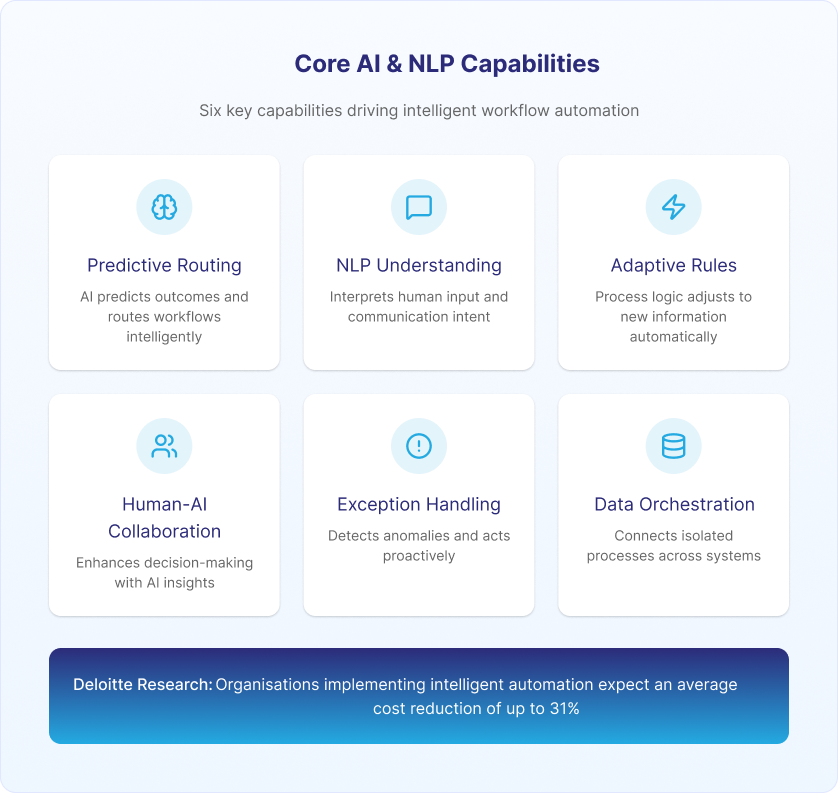
The intelligent workflow solutions are being embraced by enterprise leaders in large numbers due to the fact that they remove the bottlenecks in processes that tend to be invisible when tracking the process manually. Research from Deloitte indicates that organisations implementing intelligent automation expect an average cost reduction of up to 31 per cent, along with improved productivity, faster decision-making, and enhanced data visibility.
AI and NLP as Catalysts for Enterprise Automation
Enterprise automation with AI and NLP goes far beyond optimising back-office operations. It transforms the entire process ecosystem across finance, HR, procurement, customer experience, operations, and IT. The real value lies in orchestration, connecting processes that were previously isolated.
Below are some core capabilities driving enterprise-wide impact:
1. Predictive Process Routing
AI predicts outcomes based on historical patterns, such as approval times, wait times, potential rejections, or process deviations. Workflows can then be routed intelligently to prevent delays, reduce rework, and ensure timely completion.
2. Contextual Understanding through NLP
NLP-powered systems read text, interpret human input, and understand the intention behind communication. This capability enables automated onboarding forms, contract interpretation, invoice categorisation, and customer request understanding without human dependency.
3. Adaptive Process Rules
Traditional automation is based on fixed rules, whereas systems with AI adapt to new information to change the process logic. Indicatively, a risk assessment workflow can automatically readjust the thresholds when market conditions vary.
4. Human-AI Collaboration
AI enhances, rather than replaces, human decision-making. By surfacing insights, summarising complex data, and presenting recommended actions, AI allows teams to focus on exceptions and strategic priorities.
5. Intelligent Exception Handling
Practical Use Cases of AI-Powered Workflow Management
The applications of AI-powered workflow management span multiple functions across the enterprise:
Finance and Accounting
- Automated invoice classification using NLP
- AI-driven fraud detection
- Intelligent expense report verification
- Predictive cash-flow forecasting
Finance teams adopting AI business process automation report up to a 46 percent reduction in time spent on manual reconciliation activities, according to EY.
Customer Support
- AI chat routing using NLP to identify customer intent
- Automated response generation
- Predictive escalation handling
- Service personalisation based on sentiment analysis
For organisations with large contact centres, AI workflows reduce handling times by 20 per cent, as cited by Gitnux.
HR and Talent Operations
- Automated CV screening
- Intelligent interview scheduling
- Employee query management via NLP chatbots
- Policy interpretation and compliance workflows
These enhancements support a more efficient and consistent employee experience.
Supply Chain and Operations
- Real-time inventory tracking
- Predictive maintenance
- Automated quality checks
- Vendor communication automation
AI-based workflows enable faster fulfilment cycles and help companies mitigate disruptions before they impact customers.
Architectural Foundations of Intelligent Workflow Management
Implementing intelligent workflows requires more than adding automation tools. Enterprises need a robust digital foundation that ensures reliability, scalability, and interoperability. Key architectural elements include:
1. Unified Data Layer
AI systems depend on clean, consolidated data. Integration across ERP, CRM, and custom systems ensures continuous insights that fuel accurate predictions and contextual automation.
2. AI Models and NLP Engines
The intelligence layer, which consists of deep learning, language models, classification algorithms, entity extraction, and semantic search, is essential for effective communication, understanding, and decision-making.
3. Workflow Orchestration Platform
This platform connects processes, triggers automation, monitors performance, and provides a deep view of operational dependencies.
4. Governance and Compliance Controls
AI workflows must adhere to data governance standards, auditability, and ethical guidelines. Enterprises need transparent AI governance frameworks to build trust and maintain regulatory compliance.
The Strategic Value of AI-Powered Workflow Management
Adopting AI-led workflow automation is not simply a technology upgrade; it is a strategic step that strengthens competitiveness. The advantages extend across efficiency, agility, transparency, and resilience.
- Cost optimisation: AI reduces manual labour, errors, and process redundancies.
- Enhanced accuracy: NLP ensures precise interpretation of information, lowering exceptions.
- Faster turnaround times: Intelligent routing and predictive insights accelerate processes.
- Empowered workforce: Teams focus on analytical work instead of repetitive tasks.
- Improved customer experience: AI responds faster and more accurately across touchpoints.
- Scalability: Automated systems respond effectively to increased workloads without operational strain.
A study by PwC emphasises that AI could contribute up to USD 15.7 trillion to the global economy by 2030, with process efficiencies forming one of the strongest contributors.
What the Future Holds
As machine learning, large language models, and real-time analytics continue to evolve, enterprise workflows will progress toward deeper autonomy. Systems will soon interpret context with near-human understanding, self-adjust as business conditions shift, collaborate fluidly with human teams, and surface insights even before leaders request them.
This trajectory places AI-powered workflow management at the heart of enterprise transformation, shaping how organisations operate, innovate, and scale. Companies that choose to invest now will gain compounding advantages in speed, intelligence, and operational excellence, setting the foundation for a more adaptive and future-ready business.
Transform your operations with intelligent workflow solutions. Connect with us to discuss your automation goals.