
From Data Hubs to Decision Hubs: The Next Era of Enterprise in KSA
By 2034, the Information and Communication Technology (ICT) market of Saudi Arabia is projected to reach a value of around USD 106.77 billion with a 9%-10% CAGR. As the digital economy is growing, data becomes the cornerstone of enterprise development and innovation. Over time, organisations have invested in developing robust data hubs to store, manage, and integrate their information assets. However, with the acceleration of enterprise digital transformation in KSA in line with Vision 2030, companies are realising that only data ownership is no longer sufficient.
The next generation is to shift data into actionable decisions that can generate measurable results. This development introduces decision hubs – a higher smart layer that enables organisations to transition from hindsight-driven reporting to foresight-based action. This blog discusses how data hubs are evolving into decision hubs in response to challenges and opportunities of a fast-changing economic environment.
The Current Landscape of Data in KSA Enterprises
In the past ten years, KSA has established itself as a regional leader in enterprise transformation. Data hubs have become part of the daily operations of government institutions and private businesses. The systems integrate data to ensure it is centralised, secure, and accessible.
However, challenges prevail. The lack of cross-departmental, siloed information visibility and agility has remained an issue in many organisations. Traditional systems, scaling issues, and incompatible governance very often erode efficiency. Though data hubs are quite useful for organising and storing information, they are inherently retrospective, as they focus on the past rather than the future.
With new technologies, such as AI in enterprise and advanced analytics, businesses in KSA must no longer wait for the data to step in, but take smart actions. And that is where the conversion from data hubs to decision hubs enters.
What Makes a Decision Hub Different
A decision hub is established on a data hub with enhanced capabilities. It is a smart ecosystem, which means a combination of data, analytics, and AI-based insights and business processes.
The main characteristics of decision hubs include real-time analytics, predictive modelling, digital enterprise solutions in KSA, automated workflows, and scenario-driven planning. Unlike traditional reporting dashboards, decision hubs allow leaders to experiment with strategies, simulate results, and make bold decisions in real time.
This represents a massive digital transformation system, in which operational data is transformed into a framework that enables predictive and prescriptive action. Decision hubs support the creation of agility and precision in highly dynamic markets by integrating digital business architecture into daily processes.
Why KSA Enterprises Must Transition Now
The need to shift data hubs into decision hubs aligns with the Kingdom’s Vision 2030, which focuses on innovation, the growth of the digital economy, and global competitiveness.
According to recent reports, artificial intelligence is projected to represent 12.4% of the kingdom’s GDP across Saudi Arabia. This figure underscores the scale of opportunity for enterprises in Saudi Arabia that evolve from data hubs to decision hubs, harnessing AI and analytics to translate insight into measurable action.
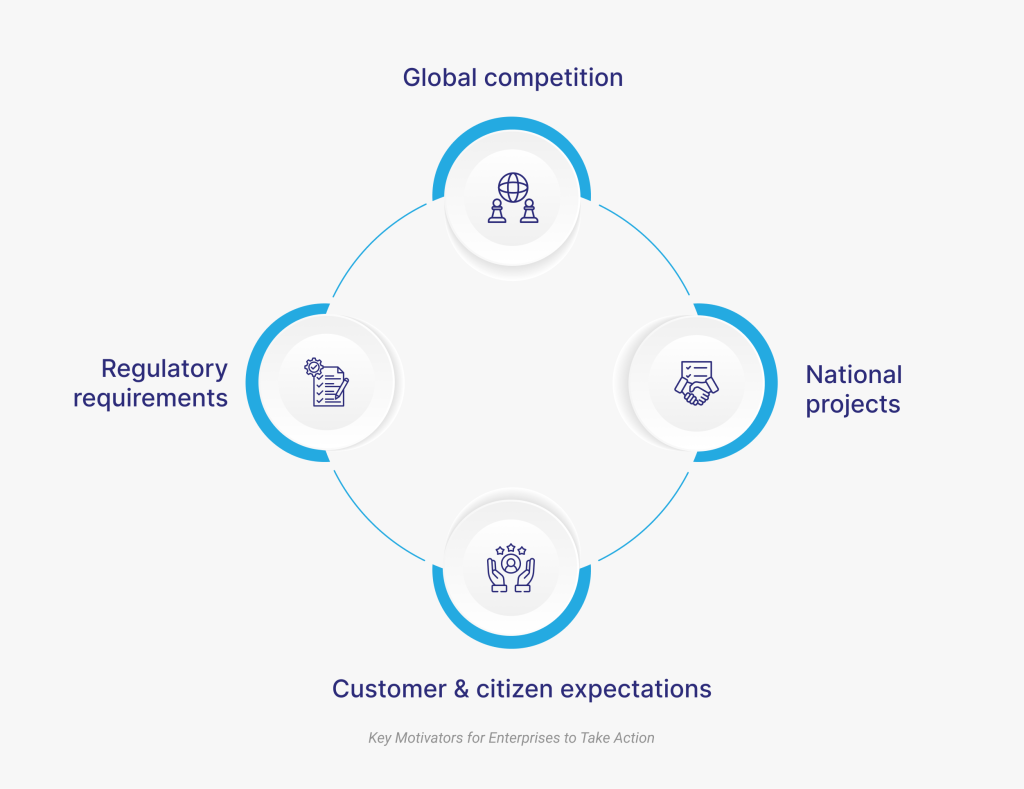
Factors that highlight why enterprises should take action:
- Global competition: KSA evolves into an international investment hub. So, local businesses must compete on a global scale, supported by digital transformation and an enterprise framework.
- Customer and citizen expectations: Customers increasingly demand seamless, digital-first user experiences, whether in government or retail communications.
- Regulatory requirements: With stricter governance around privacy, compliance, and sustainability, decision hubs ensure that enterprises are audit-ready and responsive.
- National projects: Smart cities, fintech, healthcare, renewable energy, and any other project should provide data-driven decision-making examples that can inform policy and action.
The benefits of relocating to decision hubs include positioning KSA businesses relative to national goals and future-proofing their work as a more digital-first environment approaches.
Building the Foundation for Decision Hubs
The shift from data hubs to decision hubs requires not just a change in technology but also strategic alignment and preparation of the culture. To establish the foundation, the enterprises in KSA could undertake a few steps:
- Promote effective governance: Have clear policies to promote reliable, accurate, and standard data
- Invest in cloud-native platforms: Scalable, flexible platforms are at the heart of enterprise digital transformation in KSA
- AI and analytics: AI adoption in business provides predictive and prescriptive analytics, which can improve results
- Digital business architecture mindset: Advancing the degree of integration beyond the IT systems to encompass agility and visibility of enterprise processes
- Upskill workforce: Train workers to read, understand, and act upon insights to develop information-based decision-making
Conclusion
Businesses in KSA are on the edge of critical change. Even though they laid out the information management foundation at the data hubs, the future is decision hubs, which are smart platforms supporting sustainable innovation.
The combination of digital enterprise solutions in KSA, like decision hubs, effective governance, and professional leadership, can make the Kingdom successfully enter into a new era of smart decision-making.
This effort is enhanced by SquareOne, a strategic partner that excels in building digital transformation architecture by seamlessly connecting decision hubs to the diverse enterprise ecosystem.
Let SquareOne help you to unlock the shift from data hubs to decision hubs across your enterprise.