
A Comprehensive Guide to Voice-Enabled AI Chatbots for Enterprise Operations
According to Gartner, by 2028, nearly 30% of Fortune 500 companies are expected to deliver customer service through unified AI-enabled channels that combine voice, chat, and visual interfaces. This points to a clear shift in how enterprises approach engagement and operations.
Organisations are under pressure to improve efficiency while delivering seamless user experiences, but traditional chatbots remain limited by structured inputs and shallow interactions. Voice-enabled AI chatbots offer a more natural, responsive way to engage with systems.
With enterprise AI chatbot services and enterprise conversational AI platforms, businesses are improving workflows, decision-making, and overall system interaction. This blog explores the role, working, and impact of voice AI chatbots in enterprise operations.
The Emergence of Voice-Enabled AI Chatbots in Enterprises
Voice AI chatbots, also known as chatbot voice assistants or conversational AI voice assistants, represent the next stage in conversational automation. Unlike text-based systems, they interpret spoken input, process intent in real time, and deliver responses through natural speech.
This transformation simplifies interactions, allowing users to engage with systems more intuitively without navigating interfaces or structured inputs. For firms, it enables faster access to information, reduces manual effort, and improves responsiveness. Modern voice AI chatbots now function as intelligent assistants that execute workflows, initiate transactions, and support decision-making at scale.
Decoding the Working Framework of Voice AI Chatbots
Voice-enabled AI chatbots use a mix of technologies to enable seamless interactions. Voice recognition converts spoken input into text, while Natural Language Processing (NLP) identifies intent and context, with machine learning improving accuracy over time.
Text-to-speech turns responses into a natural voice, and these systems connect with CRM, ERP, HR, and other business tools to support everyday operations.
Through enterprise conversational AI platforms, these chatbots trigger workflows, retrieve data, and maintain context across interactions, enabling voice commands to directly drive operational actions.
The Enterprise Edge: Benefits of Voice AI Chatbots
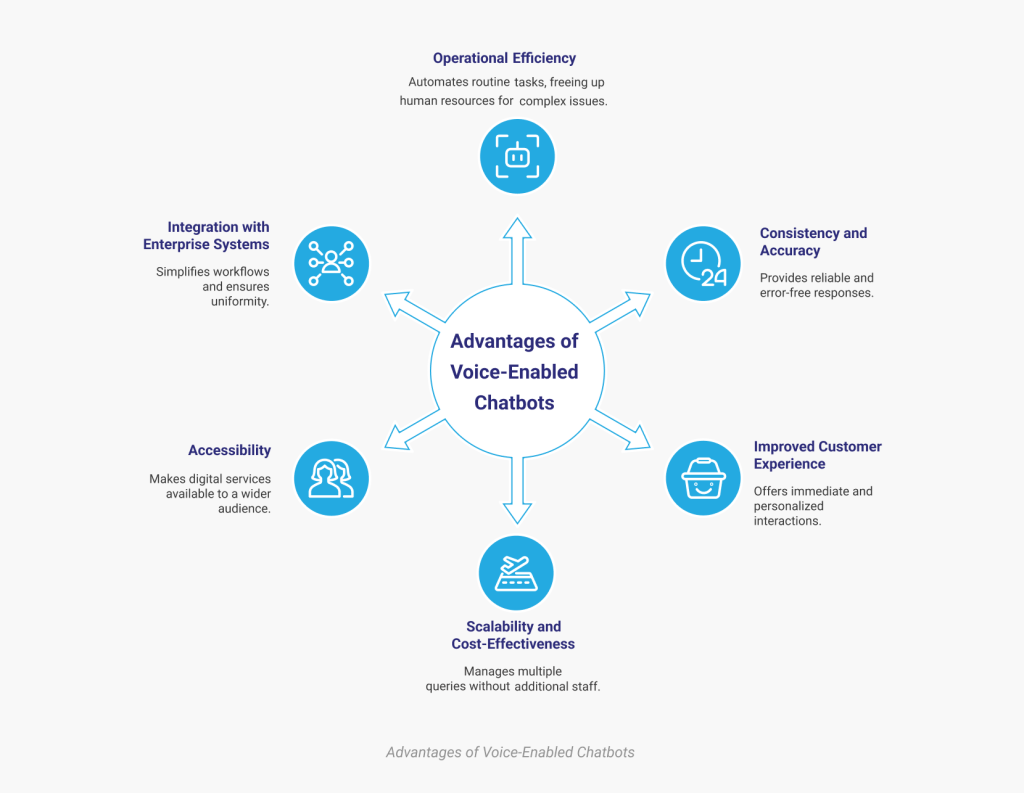
Voice AI chatbots enhance enterprise operations through automation, eliminating repetitive queries and allowing teams to concentrate on important activities. This helps in ensuring accurate and consistent communication through validated data, hence facilitating enterprise communication.
Voice interactions help in improving customer engagement through quick and more intuitive interactions, thus allowing an enterprise to scale up without having to increase human resources. It also makes interactions more accessible, especially for users who find difficulties in using text-based interactions.
With the support of a reliable enterprise AI chatbot agency, these capabilities translate into cost efficiency, better service quality, and faster execution.
Business Applications of Voice AI Technology
Voice AI chatbots are being adopted across industries due to their flexibility and impact. In healthcare, they assist with appointment scheduling, patient reminders, and preliminary assessments, improving both efficiency and patient engagement.
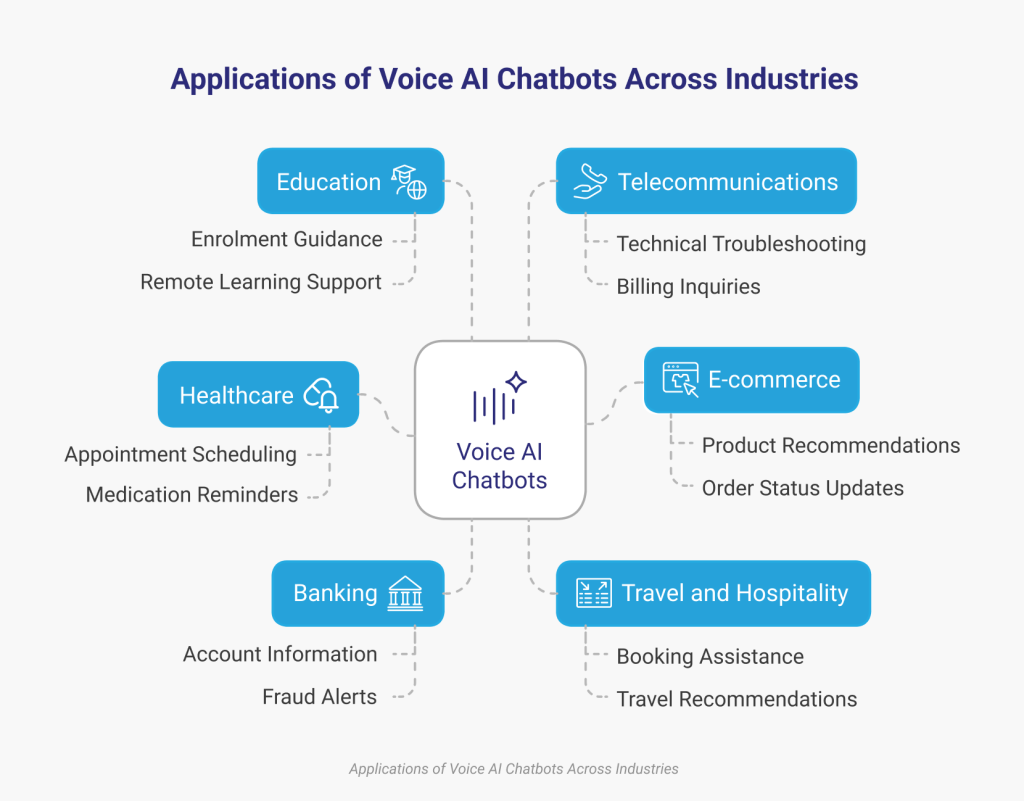
- In e-commerce, conversational AI voice assistants help users find products, track orders, and manage returns through voice interactions, improving the shopping experience.
- In banking, voice AI chatbots provide account information, flag unusual activity, and offer financial guidance with greater speed and accuracy.
- In travel and hospitality, these systems streamline bookings, deliver personalised recommendations, and provide real-time updates, ensuring smoother customer journeys.
- Educational institutions assist chatbot voice assistants to guide admissions, address queries, and support remote learning environments.
- Telecommunications companies rely on voice AI chatbots to resolve technical issues, manage billing queries, and assist with service changes, reducing reliance on call centres.
These applications highlight how voice-enabled automation is not limited to customer interaction but extends deeply into operational workflows.
Selecting the Best Enterprise AI Chatbot Partner
The success of voice AI implementation depends on selecting the best agency for enterprise AI chatbots. Key considerations include scalability, seamless integration, and compliance with data security standards.
A capable partner ensures alignment with existing systems and evolving business needs. SquareOne, for example, enables organisations to deploy enterprise AI chatbot services that support both immediate goals and long-term strategy.
With a trusted enterprise AI chatbot partner, businesses can reduce costs, improve service quality, and speed up operations.
The Future of Conversational AI Voice Assistants
According to Gartner, 40% of enterprise applications will feature task-specific AI agents by 2026, up from less than 5% today. In the future, enterprise conversational AI chatbots will be more predictive, multilingual, and bespoke.
With IoT integration, they will trigger complex workflows across connected systems. Over time, conversational AI voice assistants will move beyond just responding to requests and start anticipating needs, helping teams make better decisions.
In Conclusion
Voice-enabled AI chatbots are transforming enterprise operations by combining automation with intuitive interaction, streamlining workflows, and enhancing user experiences.
By leveraging enterprise AI chatbot services and advanced enterprise conversational AI platforms, organisations can unlock meaningful operational and strategic value. As adoption grows, voice AI chatbots will play a key role in how enterprises operate, engage, and scale.